Dollar figures in this piece are for tax year 2026.
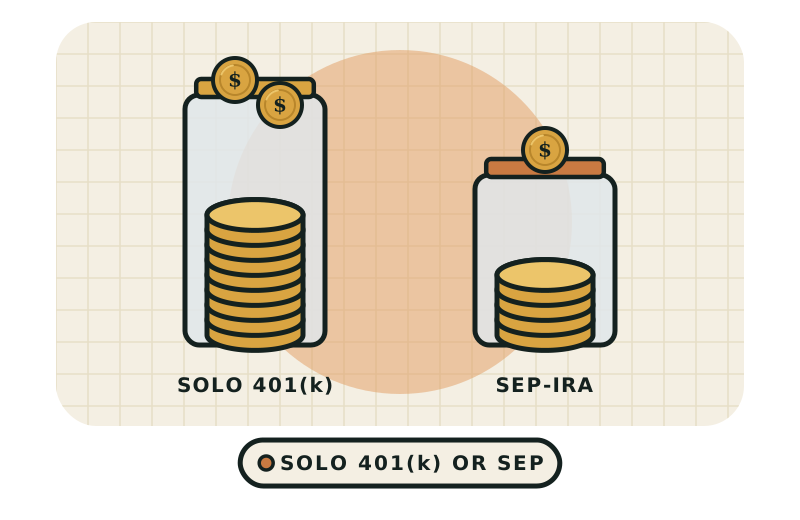
For a self-employed person with no employees, a solo 401(k) usually allows a much larger 2026 contribution than a SEP-IRA until profit gets high. A SEP-IRA takes about 20% of your net self-employment earnings, up to $72,000. A solo 401(k) lets you also defer up to $24,500 of your own earnings as an employee, then adds the same employer share on top, under the same $72,000 ceiling. In the example below, a sole proprietor with $80,000 of profit can put away about $14,870 in a SEP-IRA and about $39,370 in a solo 401(k).
The gap closes as profit rises. The SEP wins on simplicity and on how it treats employees. Below are the 2026 limits, both plans computed at six profit levels, the deadlines for the 2026 year, and the mistakes that trip people up. For the surrounding calendar, see retirement contribution deadlines.
The 2026 limits, side by side
A SEP-IRA is employer money only. The business contributes to an IRA in your own name. For an employee the cap is the lesser of 25% of compensation or the annual dollar limit, $72,000 for 2026, with compensation counted only up to $360,000. For you as the owner, the 25% is cut to an effective 20% of net earnings, for a reason covered in the next section. Contributions are optional each year.
A solo 401(k) is an ordinary 401(k) plan with one participant. Pub. 560 treats a plan as a one-participant plan when it covers only you, or you and your spouse, and you own the entire business. You wear two hats. As the employee you can defer up to $24,500 for 2026. As the employer you add a profit-sharing contribution, calculated the same way as the SEP amount. Employee and employer money together cannot exceed the lesser of 100% of your compensation or $72,000.
Catch-up contributions sit outside that $72,000 limit. A participant who is 50 or older at the end of 2026 can add $8,000. One who reaches 60, 61, 62 or 63 during the year can add $11,250 instead, if the plan allows it.
How the two plans compare
SEP-IRA
- Who contributesEmployer only
- Employee deferralNone
- Employer share for an ownerAbout 20% of net earnings
- Overall ceiling$72,000
- Roth optionRoth SEP IRA, if the plan allows it
- Who it can coverOwner and every eligible employee
- Set-up deadline for 2026Return due date with extensions
- Annual filingUsually none with Form 5305-SEP
Solo 401(k)
- Who contributesYou as employee, plus you as employer
- Employee deferral$24,500, plus $8,000 catch-up at 50+ ($11,250 at 60 to 63)
- Employer share for an ownerAbout 20% of net earnings, same calculation
- Overall ceiling$72,000, plus catch-up
- Roth optionRoth deferrals, if the plan allows them
- Who it can coverOwner and spouse only
- Set-up deadline for 2026Generally December 31, 2026; see the deadline section
- Annual filingForm 5500-EZ once assets pass $250,000
Federal rules for 2026 as described in Pub. 560. Provider terms vary; ask what a specific plan document allows.
See it as a table
| SEP-IRA | Solo 401(k) | |
|---|---|---|
| Who contributes | Employer only | You as employee, plus you as employer |
| Employee deferral | None | $24,500, plus $8,000 catch-up at 50+ ($11,250 at 60 to 63) |
| Employer share for an owner | About 20% of net earnings | About 20% of net earnings, same calculation |
| Overall ceiling | $72,000 | $72,000, plus catch-up |
| Roth option | Roth SEP IRA, if the plan allows it | Roth deferrals, if the plan allows them |
| Who it can cover | Owner and every eligible employee | Owner and spouse only |
| Set-up deadline for 2026 | Return due date with extensions | Generally December 31, 2026; see the deadline section |
| Annual filing | Usually none with Form 5305-SEP | Form 5500-EZ once assets pass $250,000 |
Why the owner's percentage is 20%, not 25%
If you own the business, your contribution is based on net earnings from self-employment, and that number is itself reduced by your contribution. Pub. 560 breaks the circle by lowering the plan rate: a 25% plan rate becomes 20% of net earnings, where net earnings means Schedule C profit minus the deduction for half of your self-employment tax. The common error is multiplying profit by 25%, which overstates the deductible amount by a quarter.
Self-employment tax in the example below follows the Pub. 505 worksheet: 92.35% of profit, then 12.4% on that amount up to the $184,500 wage base for 2026, plus 2.9% on all of it, with half of the total deductible. If you pay yourself W-2 wages through an S corporation, the picture changes. Pub. 560 says income passed through to S corporation shareholders is not net earnings from self-employment, so the contribution is based on your W-2 compensation. The S corporation pay article covers that setup.
Worked example: six profit levels
Example, hypothetical: a sole proprietor in 2026 with no employees, no W-2 job, and Schedule C profit as shown. Each contribution is the maximum. I applied the Pub. 560 deduction worksheet using the 2026 limits ($24,500 deferral, $72,000 overall, $360,000 compensation cap). The first solo column is for someone under 50. The second adds the $8,000 catch-up for someone age 50 to 59.
At $40,000 of profit, a SEP allows $7,435 and a solo 401(k) allows $30,837. The solo plan gets there because the deferral is not tied to the 20% formula, only to total earnings. At $200,000, the SEP allows $37,177 against $61,677. The SEP does not reach $72,000 until profit is about $376,500, while the solo 401(k) reaches it at about $252,400. Above those points the two plans allow the same amount, except that the solo plan can still add catch-up.
- SEP-IRA
- Solo 401(k)
| SEP-IRA | Solo 401(k) | |
|---|---|---|
| $40,000 | $7,435 | $30,837 |
| $80,000 | $14,870 | $39,370 |
| $120,000 | $22,304 | $46,804 |
| $200,000 | $37,177 | $61,677 |
| $300,000 | $56,909 | $72,000 |
| $450,000 | $72,000 | $72,000 |
The solo 401(k) allows far more at modest profits, and the two meet only once profit is well into six figures.
Computed from the Pub. 560 deduction worksheet with 2026 limits; self-employment tax per Pub. 505 and the $184,500 wage base
The inputs, so you can redo it
| Net profit | Half of SE tax | Net earnings | SEP-IRA max | Solo 401(k) under 50 | Solo 401(k) 50 to 59 |
|---|---|---|---|---|---|
| $40,000 | $2,826 | $37,174 | $7,435 | $30,837 | $37,174 |
| $80,000 | $5,652 | $74,348 | $14,870 | $39,370 | $47,370 |
| $120,000 | $8,478 | $111,522 | $22,304 | $46,804 | $54,804 |
| $200,000 | $14,117 | $185,883 | $37,177 | $61,677 | $69,677 |
| $300,000 | $15,456 | $284,544 | $56,909 | $72,000 | $80,000 |
| $450,000 | $17,465 | $432,535 | $72,000 | $72,000 | $80,000 |
The form says it that way. Here is what it means.
| What you read | What it means |
|---|---|
| The part of your own earnings you choose to put in as the employee: $24,500 for 2026 | |
| The profit-sharing contribution you make as the business, calculated the same way as the SEP amount | |
| Schedule C profit minus the deduction for half of your self-employment tax | |
| Extra $8,000 at 50 or older, or $11,250 at ages 60 to 63, outside the $72,000 limit | |
| A plan that covers only you, or you and your spouse, when you own the entire business | |
| The annual report for a one-participant plan, required once assets pass $250,000 |
Deadlines for the 2026 year
The deadlines differ by plan and by which dollars you mean. A SEP can be opened and funded as late as the due date of your 2026 return including extensions, so a calendar-year sole proprietor who files an extension has until October 15, 2027. The employer share of a solo 401(k) follows the same date for deduction purposes.
The employee deferral is where people get caught. Pub. 560 lists the due date of the return for elective deferrals, but when and how you must elect the deferral comes from the plan document, which your provider writes. I would treat December 31, 2026 as the safe date to have a plan open and your deferral election made. One narrow exception covers a brand-new plan. Under the Code, a sole owner who is the only employee and adopts a 401(k) after year end can still make deferrals for the plan's first year until the filing date of the return, determined without extensions. For 2026 that date is April 15, 2027.
Three dates to put on the calendar
- December 31, 2026Safest date to have a solo 401(k) adopted and your deferral elected.
- April 15, 2027Last day to adopt a brand-new solo 401(k) after year end and make first-year deferrals.
- October 15, 2027Last day to open and fund a SEP, or fund the employer share, if you extend the 2026 return.
Roth and pre-tax choices
Pre-tax contributions reduce 2026 taxable income. Designated Roth deferrals do not, because they are not excluded from gross income, and the Pub. 560 worksheet subtracts them when it computes the deductible amount. They count against the same $24,500 limit, so the choice is about when the tax is paid, not how much can go in.
For plan years after 2022 a SEP plan can allow contributions to go into a Roth SEP IRA, and Pub. 560 says a 401(k) participant may be permitted to designate certain employer contributions as Roth. Whether your provider offers either is a separate question. The pre-tax or Roth choice depends on your income this year and your expectations for retirement, so I would run both versions through the return before picking one. The tax planning page describes how that analysis works.
Common mistakes
- Taking 25% of Schedule C profit instead of the reduced rate on net earnings, then contributing more than is deductible.
- Contributing more than the deduction limit allows. A 10% excise tax generally applies to nondeductible contributions to qualified plans and SEPs.
- Treating the $24,500 deferral as a per-plan limit. It applies to all of your elective deferrals, so a 401(k) at a day job uses up part of it.
- Opening both plans and counting each limit separately. A SEP counts as a defined contribution plan, so its contributions add to a solo 401(k)'s toward the overall limit, and Form 5305-SEP cannot be used if you maintain another qualified plan.
- Hiring a part-time employee without checking the plan. A solo 401(k) is built for the owner and spouse, and a SEP must cover eligible employees (age 21, 3 of the last 5 years, and $800 of pay in 2026).
- Forgetting the Form 5500-EZ after a plan passes $250,000 in assets. The annual report is due by the last day of the seventh month after the plan year ends.
- Contributing in a loss year. With a net loss from self-employment you cannot contribute for yourself.
The usual way versus doing it right
Guess and round
- Multiply profit by 25%
- Count each plan's limit separately
- Start the plan in the spring
Run the worksheet
- Use net earnings and about 20%, per the Pub. 560 worksheet
- Treat $72,000 as one shared ceiling and $24,500 as shared across all your deferrals
- Have the plan open and the deferral elected by December 31, 2026
What to do before year end
Estimate 2026 net profit now
Use year-to-date numbers and your quarterly estimates. The contribution limit moves with profit, so a range is better than a point.
Run the worksheet
Compute the maximum for each plan from net earnings, not profit. Compare it with what you want to save.
Choose the plan
If the SEP amount covers what you intend to save and you have or expect employees, a SEP may be enough. If you want more than that and it is just you, open a solo 401(k) before December 31.
Confirm the plan document
Ask the provider about Roth deferrals and the deadline for electing a deferral.
Make the deferral by December 31, 2026
Then fund the employer share by the return due date, April 15 or October 15, 2027 if you extend.
Deduct it correctly
A sole proprietor deducts contributions for themselves on Schedule 1 of Form 1040 (line 16 on the 2025 form), not on Schedule C.
Set a reminder for Form 5500-EZ
It is only required once plan assets exceed $250,000 or in the plan's final year.