Dollar figures in this piece are for tax year 2026.
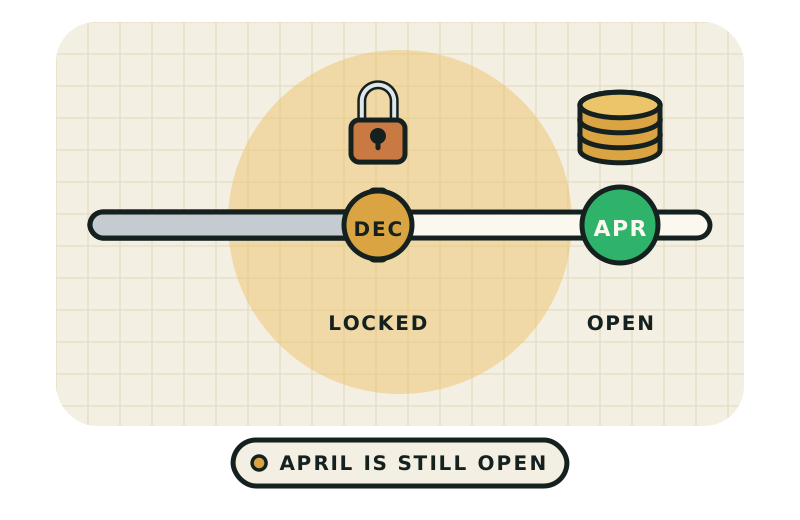
Only some retirement contributions can wait past December 31. IRA and HSA contributions for 2026 can be made through April 15, 2027, a Thursday. SEP contributions can be made up to the return due date including extensions, which is October 15, 2027 if you extend. A 401(k) employee deferral is different. For a regular employee it has to come out of 2026 pay, and only a sole owner with no employees gets a short window after year-end.
It is October 2026, so one date is close. Extended 2025 returns are due October 15, 2026, and that is the last day to fund a SEP for 2025. This page sorts each account by what it needs and when, so you can see which gaps you can still close and which you cannot.
Two clocks: the filing date and the extended date
Retirement contributions follow one of two deadlines. The first is the due date of your return without extensions, April 15 for most people. The second is the due date with extensions, which for an individual who files the automatic extension is six months later. Pub. 17 gives the pattern: a return due April 15, 2026 gets until October 15, 2026.
The difference matters because an extension does nothing for some accounts. An IRA contribution for 2026 is deemed made on December 31, 2026 only if it is made by the time prescribed for filing the return, and the Code says in so many words that extensions are not counted. A SEP works the other way and does count them. The account decides which clock applies, not your preference.
If you have already filed for more time on a prior year, the extension checklist covers what the extension changed and what it did not.
The deadlines, account by account
| Account | Last day for 2026 | Clock | Notes |
|---|---|---|---|
| Traditional or Roth IRA | April 15, 2027 | Return due date, no extensions | Tell the custodian which year the money is for |
| HSA (you or employer) | April 15, 2027 | Return due date, no extensions | You must have been eligible for the months you count |
| SEP IRA (employer contribution) | October 15, 2027 if you extend | Return due date, with extensions | Plan can be set up as late as that date |
| Solo 401(k), employer profit-sharing | October 15, 2027 if you extend | Return due date, with extensions | Plan must exist by then |
| Solo 401(k), your own deferral, new plan | April 15, 2027 | Return due date, no extensions | Sole owner with no employees only, first plan year |
| 401(k) deferral from a paycheck | December 31, 2026 | End of the tax year | Comes out of 2026 pay |
| SIMPLE IRA employer contribution | October 15, 2027 if you extend | Return due date, with extensions | Employee deferrals still run through payroll |
IRAs and HSAs: the April 15 pair
For a traditional or Roth IRA, section 219(f)(3) treats a contribution as made on the last day of the prior year if it is made on account of that year by the filing date, extensions excluded. A 2026 IRA contribution can therefore go in as late as April 15, 2027. For 2026 the limit is $7,500, or $8,600 if you are 50 or older.
Two practical points. If you contribute between January 1 and April 15, tell the custodian which year the money is for. Pub. 590-A says the sponsor can assume the current year if you do not. And you can file a return that claims a traditional IRA deduction before the contribution is made, but the contribution still has to land by the due date without extensions.
The HSA follows the same date. Pub. 969 says you can contribute for a year through April 15 of the next year, and an employer can make a contribution in that window if it is allocated to the earlier year and the employer tells you and the trustee. For 2026 the limit is $4,400 for self-only coverage and $8,750 for family coverage. The limit also depends on the months you were eligible, so read the HSA rules before you top one off.
| 2026 limit | |
|---|---|
| IRA | $7,500 |
| HSA self-only | $4,400 |
| HSA family | $8,750 |
| 401(k) deferral | $24,500 |
| Total plan additions | $72,000 |
The large numbers sit in the 401(k) and the employer-side plan, which is why the deferral deadline is the one to watch.
Instructions for Forms 1099-R and 5498 (IRA); Pub. 15-B (HSA); Pub. 560 (401(k) and plan limits), all 2026 figures
SEPs and employer contributions: the extended date
Section 404(a)(6) treats an employer payment as made on the last day of the prior year if it is made on account of that year by the return due date, and here extensions do count. Pub. 560 applies this to a SEP: the contribution deadline is the due date of the employer's return including extensions, and you can set up the SEP for the year as late as that date. For a sole proprietor on Schedule C, the employer's return is your Form 1040.
That makes the SEP the most forgiving account on the list. If you filed an extension for 2025, you can still fund a 2025 SEP through October 15, 2026 and take the deduction on the 2025 return. The limit for 2026 is the smaller of 25% of compensation or $72,000. For yourself, compensation is net earnings after the self-employment tax deduction and the contribution itself, which is why Pub. 560 has a separate worksheet. Employer profit-sharing contributions to a solo 401(k) follow the same extended date.
If you are weighing a SEP against a solo 401(k), the comparison covers the trade-offs.
The deadline language says it that way. Here is what it means.
| What you read | What it means |
|---|---|
| April 15 for most people | |
| Six months later, October 15 for a calendar-year individual who files the automatic extension | |
| The part of a 401(k) that comes out of your own pay | |
| The employer layer of a 401(k), which can be funded by the extended due date | |
| Tell the custodian which year the contribution is for | |
| An employer plan you can set up and fund as late as the extended due date |
The solo 401(k) deferral is the tricky one
A 401(k) has two layers. The employer layer (profit-sharing, match) can be funded by the extended due date, as above. Your own deferral, the part that comes out of pay, has the short fuse. For an employee, Pub. 560 says deferrals must be elected and made by the end of the tax year, and deposited within a short period. For 2026 the deferral limit is $24,500, plus the catch-up if you qualify.
SECURE 2.0 added one exception. Say you own an unincorporated business and are its only employee, and you adopt a new 401(k) after the close of the year but before the return due date. Section 401(b)(2) lets you treat the plan as adopted on the last day of that year. Your deferrals for that first plan year count if they are made before the filing date, determined without regard to extensions. For 2026 that is April 15, 2027.
The limits of that exception are the whole story. It covers a new plan, in its first plan year, for a sole owner with no other employee. An existing plan does not get a second chance, and a business with a W-2 employee does not qualify. One passage in Pub. 560, in its definitions, says an owner can make deferrals by the filing deadline including extensions. The Code and the Pub. 560 setup discussion both say without extensions, so I would plan to April 15. Your plan document controls what the plan will actually accept, so check it before relying on any of this.
Example, hypothetical: what is still open on January 2
Example, hypothetical: a 52-year-old self-employed consultant has family HDHP coverage all of 2026. The consultant starts the year with no plan and has made no retirement or HSA contributions by December 31, 2026. Assume no employees, and income high enough that every contribution below is allowed and deductible. In practice the IRA deduction is a separate test.
Through April 15, 2027, which is 105 days after year-end, the consultant could still add up to $8,600 to an IRA (the $7,500 limit plus the $1,100 age-50 amount) and $8,750 to the HSA. By adopting a solo 401(k) in that window, the consultant could also make up to $24,500 of first-year deferrals. That adds up to $41,850 of ceiling after the year ended. An extension adds nothing to the IRA, HSA or deferral figures. The $24,500 would be out of reach if the same person had a W-2 employee, or had adopted a plan in an earlier year and missed the paycheck deadline.
The chart below puts the three dates on one line. The same person would also have until October 15, 2027, 288 days after year-end, to fund a SEP or an employer profit-sharing contribution, subject to the 25% limit.
- 10 days401(k) paycheck deferrals; year-end
- 2105 daysApril 15, 2027: IRA, HSA, new solo 401(k) deferral
- 3288 daysOctober 15, 2027: SEP and employer contributions (extended)
April 15 is 105 days after year-end and the extended date is 288 days after.
Common mistakes
- Filing an extension and assuming an IRA or HSA contribution can wait until October.
- Sending an IRA contribution in February without saying it is for the prior year, so it gets reported for the current one.
- Assuming a paycheck 401(k) deferral can be made after December 31 when you have a W-2 job or any employees.
- Using the sole-owner first-year deferral rule for a plan that already existed.
- Forgetting that a SEP deduction for yourself is figured on net earnings after the contribution itself, so the headline 25% overstates it.
- Planning around April 15 without checking the actual due date for that year when it falls on a weekend or holiday.
The usual way versus doing it right
Wait for the extension
- Assume an extension also extends IRA and HSA contributions
- Send the February IRA contribution without naming the year
- Plan to make up paycheck deferrals after year-end
Match each account to its clock
- Fund the IRA and HSA by April 15 and name the year
- Use the extended date only for a SEP or employer contribution
- Raise paycheck deferrals before December 31
What to do
Before October 15, 2026
If you extended your 2025 return, decide now on a 2025 SEP or profit-sharing contribution.
By December 31
Raise paycheck 401(k) deferrals and any payroll HSA election now, since these cannot be made up after year-end. Confirm which of your accounts have headroom.
By December 31
If you want a solo 401(k), adopting it before year-end is cleaner than relying on the late-adoption rule, which needs a sole owner and a first plan year.
January to April 15, 2027
Fund the IRA and HSA, and tell each custodian the contribution is for 2026.
April 15, 2027
Last day for IRA, HSA and a sole owner's first-year deferral. Pay any balance due, because an extension does not move that.
If you extend
Fund a SEP or employer profit-sharing contribution by October 15, 2027 and keep the deposit record with the return.
Where this connects
Which account to pick, and in what order, is a planning question. The retirement stacking article walks through the order for high earners, and the tax planning service is where I run the numbers for a specific situation. Whichever account you use, the deadlines above are set by statute, and a missed one cannot be repaired by asking nicely.