Dollar figures in this piece are for tax year 2026.
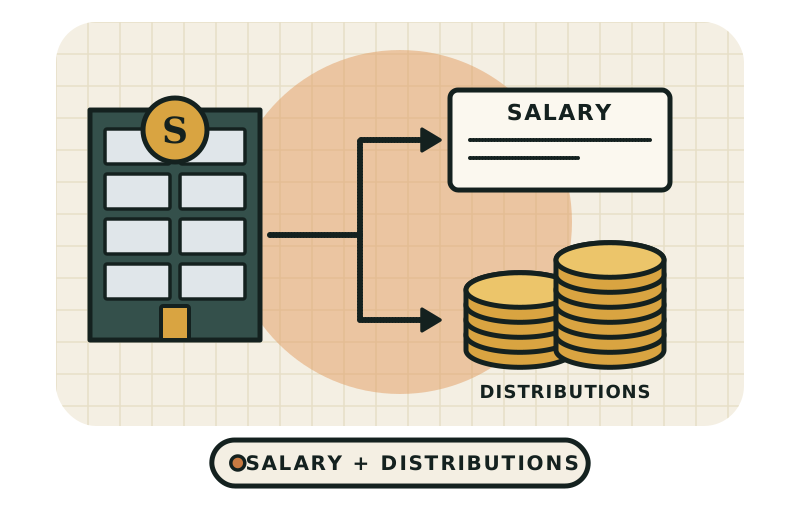
An S corporation owner is paid two ways, and each follows its own rules. Salary is wages. It goes through payroll, carries Social Security and Medicare tax, and is taxed to you when paid. A distribution is money the company already earned, and it is tax-free only up to your basis in the stock. Profit is taxed to you on your K-1 whether or not you take any of it out.
The order matters: salary first, then profit passes through and raises basis, then distributions come out of basis, and losses are limited to what is left. This page covers basis, distributions and that order. Picking the salary number itself is in what reasonable salary actually means, and whether to elect S status at all is in S-corp vs. LLC. Figures are for 2026 unless a heading says otherwise.
Two paychecks, two sets of rules
For payroll tax, wages mean all remuneration for employment. Social Security tax is 6.2% from the employee and 6.2% from the employer, up to a wage base of $184,500 for 2026. Medicare is 1.45% from each side with no cap. An owner who works in the business and holds S stock is paid wages for that work. The Form 1120-S instructions say distributions and other payments to an officer must be treated as wages to the extent they are reasonable compensation for services.
A distribution is different in kind. Under section 1368, for an S corporation with no accumulated earnings and profits, a distribution is not included in your gross income to the extent it does not exceed the adjusted basis of your stock. Any excess is treated as gain from the sale or exchange of property. No payroll tax applies to a distribution, which is why the salary number gets scrutiny.
One more rule shapes how you take money out. A corporation with more than one class of stock cannot be an S corporation. Under the regulations it has one class only if all outstanding shares carry identical rights to distribution and liquidation proceeds. In practice, distributions to owners generally have to follow ownership percentages. Timing differences are a question for the company's attorney or preparer before the money moves.
Basis: the number that decides what is taxable
Your stock basis starts with what you paid for the stock or contributed, then moves every year. The Schedule K-1 instructions adjust it in this order: up for income on your K-1, down for distributions (but not below zero), down for nondeductible expenses, then down for losses and deductions. Section 1368(d) adds a timing point. For a distribution made during the year, basis is figured after counting that year's income increases, so profit earned this year can shelter a distribution taken this year.
Basis has a second layer. If you lend money to the corporation, the balance owed to you is debt basis, and losses beyond your stock basis can be used against it. Distributions do not reduce loan basis. A loan you only guarantee or co-sign is not part of it unless you actually make a payment under the guarantee. Whether an advance is a bona fide loan depends on the facts, so the paperwork needs to exist before the money moves.
The IRS expects you, not the corporation, to keep the running basis. The K-1 gives you the year's items, and Form 7203 is how the stock and debt basis computation is reported. A K-1 does not show your basis.
The order of operations each year
| Step | What happens | Effect |
|---|---|---|
| 1 | Salary is paid and payroll tax is withheld and matched | Reduces the company's profit; no effect on basis by itself |
| 2 | Your share of income passes through on the K-1 | Basis goes up, and you are taxed on it either way |
| 3 | Distributions come out of basis | Tax-free up to basis; the excess is gain |
| 4 | Nondeductible expenses reduce basis | Basis cannot go below zero |
| 5 | Losses and deductions reduce basis | Allowed only up to stock plus loan basis; the rest carries forward |
Worked example: salary, basis and a loss year
Example, hypothetical, 2026: a single-owner S corporation earns $150,000 before any pay to the owner. The owner takes an $80,000 W-2 salary. The corporation also pays the 7.65% employer share of payroll tax on that salary, $6,120, which reduces its profit. That leaves $63,880 of ordinary income on the owner's K-1, taxed to the owner whether or not it is withdrawn.
Now put the same $150,000 of profit on Schedule C. Self-employment tax is 12.4% plus 2.9% on 92.35% of net earnings, here $138,525, which comes to $21,194. Under the S corporation, payroll tax is 15.3% of the $80,000 salary, or $12,240 (employee and employer halves together), and nothing is owed on the distribution. The difference is about $8,954. That figure leaves out income tax, the qualified business income deduction, state taxes, and the added cost of payroll and a corporate return, and any of them can move the answer.
The K-1 says it that way. Here is what it means.
| What you read | What it means |
|---|---|
| Roughly what you paid in, plus income passed through, minus distributions and losses | |
| Money taken out of the company that is not salary; tax-free up to basis | |
| What the company owes you on loans you made to it, which can absorb losses past stock basis | |
| The running total that distributions come out of first when the company has leftover C corporation earnings | |
| The form that computes your stock and debt basis | |
| A different right to distributions among shares, which can end S status |
| Social Security and Medicare tax | |
|---|---|
| Schedule C self-employment tax | $21,194 |
| S corp, $100,000 salary | $15,300 |
| S corp, $80,000 salary | $12,240 |
| S corp, $60,000 salary | $9,180 |
Payroll tax falls as more of the profit is taken as distributions, but a lower salary is the number most likely to be challenged.
Computed: 15.3% of salary; 15.3% of 92.35% of $150,000 on Schedule C. 2026, below the $184,500 wage base.
The salaries in the chart illustrate the arithmetic. They are not recommendations. A thinner salary saves more payroll tax and invites the question the other article is about.
Now the basis side. Say the owner put in $10,000 to start the company. In year one, the $63,880 of income raises basis and the owner takes $50,000 of distributions, leaving a basis of $23,880. In year two, the company has a $30,000 loss and the owner takes a $10,000 distribution. The distribution comes first and leaves $13,880 of basis, so only $13,880 of the loss is allowed. The other $16,120 is disallowed but carries forward indefinitely. In year three, $40,000 of income and a $15,000 distribution leave $25,000 of basis, enough to use the whole $16,120 carryforward and end the year with $8,880.
| Stock basis | |
|---|---|
| Start of year 1 | $10,000 |
| End of year 1 | $23,880 |
| End of year 2 | $0 |
| End of year 3 | $8,880 |
Year two's loss is limited to the basis left after the distribution; year three's income frees the carryforward.
Computed from the hypothetical in the text; Schedule K-1 (Form 1120-S) instructions ordering
What happens when a distribution exceeds basis
If the corporation has no accumulated earnings and profits, a distribution beyond your basis is treated as gain from the sale or exchange of property. Example, hypothetical: with $5,000 of basis and a $12,000 distribution, $5,000 comes back tax-free and the $7,000 excess is gain. Basis is then zero. Basis cannot go below zero, so a later year's income raises it again, but the gain has already been recognized.
A corporation with accumulated earnings and profits, usually left over from years as a C corporation, adds a layer. Distributions come first out of the accumulated adjustments account, and to the extent they exceed it, can be treated as dividends. If the company was ever a C corporation, ask before relying on the simple rule above.
Common mistakes
- Treating the bank balance as the measure of what you may distribute, instead of basis.
- Skipping a salary entirely and taking only distributions, when the Form 1120-S instructions say payments to an officer are wages to the extent they are reasonable compensation.
- Not tracking basis, so a loss year or a large distribution produces a surprise with no worksheet to check it against.
- Guaranteeing a company loan and assuming it creates loan basis; it generally does not until you pay under the guarantee.
- Paying distributions to one owner on a different schedule or percentage from another, which can raise a second-class-of-stock question.
- Assuming a loss reported on the K-1 is deductible without checking basis, and then the at-risk and passive limits that apply after it.
The usual way versus doing it right
Go by the bank balance
- Distribute whatever cash is in the account
- Take distributions only, with no salary
- Wait for the K-1 to learn your basis
Go by basis
- Size distributions against basis plus this year's income
- Pay a reasonable salary through payroll
- Keep your own basis worksheet and Form 7203
What to do before year end
Compare salary to the work
Look at what you have been paid this year against the reasonable salary reasoning you wrote down. If the answer has changed, adjust payroll before December 31 so the W-2 matches.
Rebuild basis
Start from last year's Form 7203, or reconstruct it from the K-1s and your contributions and loans. Project this year's income and losses on top.
Size distributions against basis
Add your projected K-1 income to opening basis, subtract distributions already taken, and see how much room is left before the excess becomes gain.
Document any loans
If you are putting money into the company or taking money out as a loan, write the note, set terms and book it before year end.
Match distributions to ownership
If there is more than one shareholder, keep the percentages consistent and write down the exceptions before they happen.
Hand the numbers to your preparer early
The K-1 and Form 7203 are due with the 1120-S and the 1040, and basis questions are easier to settle in January than in March.
Who this is for
These rules apply to single and multi-owner S corporations. Accumulated adjustments, redemptions and election timing are outside this page. For the payroll mechanics of running yourself through the company, see the planned piece on S-corp owner payroll. For planning generally, see tax planning or the self-employed page.