Dollar figures in this piece are for tax year 2026.
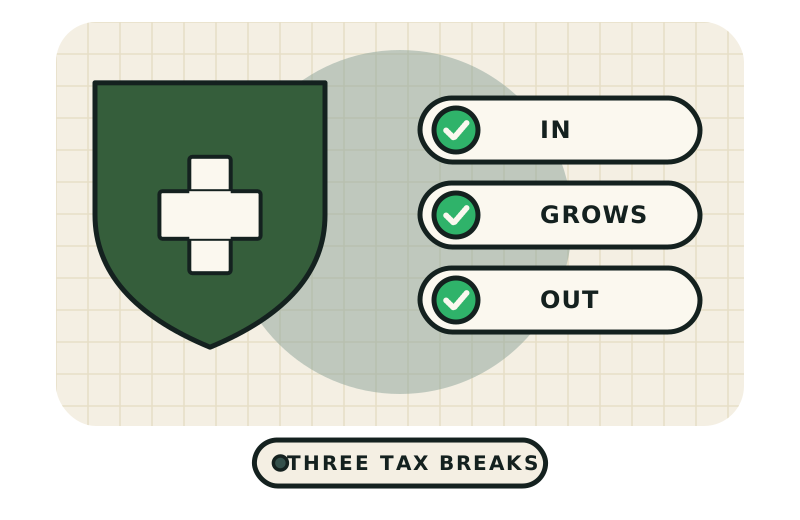
An HSA gives you three separate tax breaks. The money going in is deductible or excluded from pay, the growth is untaxed, and withdrawals for medical care are untaxed. For 2026 you can put in up to $4,400 with self-only high deductible coverage or $8,750 with family coverage, plus $1,000 if you are 55 or older. You need a qualifying high deductible health plan, and you cannot be enrolled in Medicare.
The rules break in a few predictable places. Contributions pass the limit once an employer's share is counted. Medicare starts. Someone leaves the plan too soon after using the last-month rule. Or the money goes to something that does not qualify. Each is covered below with the 2026 numbers.
The three tax breaks
- Money inYour own contributions are deductible whether or not you itemize. Employer contributions, including payroll contributions through a cafeteria plan, are excluded from your income.
- GrowthInterest and other earnings inside the account are tax free while they stay there, and unspent money carries forward year to year.
- Money outWithdrawals used for qualified medical expenses are tax free. Other withdrawals are taxed and usually carry an extra 20% tax.
Who can contribute
Eligibility is tested month by month. For a given month you qualify if you are covered by a high deductible health plan (HDHP) on the first day of that month, you have no other disqualifying health coverage, you are not enrolled in Medicare, and no one else can claim you as a dependent. Each spouse who qualifies opens a separate account. There is no joint HSA.
For 2026 a plan counts as an HDHP only if its deductible and out-of-pocket maximum fall inside the ranges below. Premiums do not count toward the out-of-pocket maximum.
2026 HDHP thresholds
| Self-only | Family | |
|---|---|---|
| Minimum annual deductible | $1,700 | $3,400 |
| Maximum deductible plus out-of-pocket | $8,500 | $17,000 |
Other coverage is where people get tripped. A general-purpose health FSA, or an HRA that pays medical expenses before you reach the deductible, generally disqualifies you. A limited-purpose FSA (dental and vision) or a post-deductible FSA does not. You can also carry accident, disability, dental, vision, long-term care and telehealth coverage. A spouse's non-HDHP family plan does not disqualify you as long as it does not cover you.
Two recent changes matter. Federal law now lets an HDHP cover telehealth and other remote care before the deductible, and the Code treats bronze and catastrophic plans bought on the exchanges as HDHPs. Get your own plan confirmed by the insurer in writing before you fund the account. The plan decides, not the label on the card.
How much you can put in
The annual limit is built from monthly limits: one-twelfth of the full amount for each month you are eligible. If you were eligible all year with the same coverage, you get the whole amount. The 2026 figures are below.
- Under 55
- Age 55 or older
| Under 55 | Age 55 or older | |
|---|---|---|
| Self-only | $4,400 | $5,400 |
| Family | $8,750 | $9,750 |
The family limit is about twice the self-only limit, and the 55-and-older catch-up adds the same $1,000 to either.
Pub. 969 (2025 edition, 2026 figures) and 26 U.S.C. 223(b)(3); computed
Every source counts toward the same ceiling: your own deposits, your employer's contributions (including those through a cafeteria plan) and contributions from family members or anyone else. If both spouses are 55 or older, each can add the $1,000, but each makes that deposit to their own account. Medicare only cuts the limit. It drops to zero starting with the first month you are enrolled, including months covered by retroactive enrollment.
The deadline to fund a year is the filing deadline without extensions, April 15 of the following year in the IRS's own examples. An employer can also fund a prior year during that window if it tells you and the trustee the money belongs to the earlier year.
Payroll deposits versus writing a check
How the money gets in changes the tax result. Money that goes in through a salary reduction arrangement in an employer's section 125 cafeteria plan is not wages, so it avoids income tax withholding and Social Security and Medicare taxes. A payroll deduction outside a cafeteria plan, or a deposit from your own bank account, is included in wages for those taxes. You then take the deduction on your return, which cuts income tax but does not recover the payroll tax.
Either way, it is all reported on Form 8889, filed with your Form 1040 whenever the account had any activity, even if only an employer contributed. Your employer's share shows in box 12 of your W-2 with code W, and the trustee reports contributions on Form 5498-SA. Match the deduction line to those two documents so payroll deposits, already excluded, are not deducted a second time.
The last-month rule and its testing period
If you are an eligible individual on the first day of the last month of your tax year, December 1 for most people, you are treated as eligible for the whole year and can contribute the full annual amount for your coverage type. That is what lets someone who joins an HDHP in the fall fund a full year.
The price is a testing period. For a calendar-year taxpayer, it runs from December 1 through the end of December of the following year. If you stop being eligible during that window for any reason other than death or disability, the extra contributions you could not have made without the rule come back into income in the year you fell out, plus a 10% additional tax on that amount.
Example, hypothetical: a 52-year-old starts family HDHP coverage on July 1, 2026 and contributes the full $8,750 under the last-month rule. Without the rule, six eligible months would allow $8,750 × 6 ÷ 12 = $4,375. In March 2027 the person leaves the plan. The $4,375 difference (8,750 minus 4,375) is added to 2027 income, and the 10% additional tax is $437.50. The Form 8889 worksheet runs this calculation.
The form says it that way. Here is what it means.
| What you read | What it means |
|---|---|
| For 2026, a plan with a deductible of at least $1,700 self-only or $3,400 family, and a deductible plus out-of-pocket maximum of no more than $8,500 or $17,000 | |
| Someone who meets the HDHP, other-coverage, Medicare and dependent tests on the first day of the month | |
| If you are eligible on December 1, you can contribute the full-year amount, but you must stay eligible through December 31 of the following year | |
| For a calendar-year taxpayer, December 1 through the end of December of the following year | |
| A deposit that is neither excluded as an employer contribution nor deductible, taxed 6% a year while it stays in | |
| Your employer's HSA contributions for the year | |
| Section 213(d) medical care for you, your spouse or your dependents, to the extent insurance does not pay for it |
Excess contributions, and a worked example
An excess contribution is any deposit that is neither excluded as an employer contribution nor deductible. It is not deductible, and a 6% excise tax applies for every year it stays in the account. Employer deposits above your limit are included in your income.
Example, hypothetical: a 40-year-old with self-only HDHP coverage has $3,000 deposited by an employer through payroll in 2026. Not knowing this, the person also deposits $2,000 directly. Total deposits are $5,000 against a limit of $4,400, so $600 is excess. Only $1,400 ($4,400 minus $3,000) of the direct deposit is deductible. Left alone, the 6% tax is $36 for 2026, and it repeats each year the $600 remains.
The fix is cheap if you move before the return is due. Withdraw the excess and its earnings by the due date of the return, including extensions, and the 6% tax does not apply to the amount withdrawn. The earnings are reported as other income. If you filed on time without withdrawing, the Form 8889 instructions allow a withdrawal up to six months after the original due date, with an amended return.
A $600 excess costs $36 a year if left alone and nothing if withdrawn on time.
Spending the money
A qualified medical expense is medical care as defined in Code section 213(d) for you, your spouse and your dependents, to the extent insurance does not pay for it. It must be incurred after the account was established. The last-month rule gets you the contribution. It does not make expenses from before the account existed eligible.
HSA money generally cannot pay insurance premiums. The exceptions are long-term care insurance, COBRA continuation coverage, coverage while receiving unemployment compensation, and Medicare and other health coverage once you are 65 or older, though not Medigap. You cannot also deduct on Schedule A an expense paid with a tax-free HSA withdrawal.
Withdrawals not used for qualified medical expenses are taxed as income and, in most cases, carry a 20% additional tax. A $1,000 non-qualified withdrawal before age 65 therefore costs $200 on top of the ordinary income tax. The 20% does not apply after you reach 65, become disabled or die. The trustee reports withdrawals on Form 1099-SA. You keep the records showing the expense was medical, unreimbursed and not already deducted, and you do not send them in with the return.
Common mistakes
- Counting only your own deposits and forgetting the employer's share, so the combined total exceeds the limit.
- Contributing to an HSA while enrolled in a general-purpose health FSA or a first-dollar HRA.
- Continuing to contribute after Medicare starts, including months covered by backdated enrollment.
- Using the last-month rule and then dropping HDHP coverage before the end of the testing period.
- Assuming a plan is an HDHP without checking its deductible and out-of-pocket maximum against the year's thresholds.
- Paying a non-qualified expense or an ineligible premium from the account and not planning for the 20% tax.
The usual way versus doing it right
Fund it and hope
- Count only your own deposits
- Assume the plan is an HDHP
- Pay what is handy from the account
Check every source
- Add up your deposits, your employer's and family members' against the limit
- Confirm the plan is an HDHP with the insurer in writing
- Keep receipts showing each withdrawal was a qualified, unreimbursed medical expense
What to do
Confirm the plan
Ask the insurer in writing whether the plan is an HDHP for 2026, and whether any FSA or HRA you have is limited-purpose or post-deductible.
Add up every source
Before year-end, total your deposits, your employer's contributions and anything a family member added, and compare the sum to your limit.
Check Medicare timing
If you are near 65, plan the last month of contributions around your Medicare start date and ask about backdating.
Decide on the last-month rule
If you are joining a plan late in the year, weigh the larger deposit against holding the HDHP through December of the following year.
File Form 8889
Reconcile it to your W-2 box 12 code W and the trustee's Form 5498-SA, and keep receipts for every withdrawal.
Fix an excess early
If you find one, ask the trustee for a withdrawal of the excess and its earnings before your return's due date, including extensions.
For a broader look at where an HSA fits among your other deductions, see the tax planning page. If you would like a second set of eyes on your contributions before year-end, the contact page is the place to start.