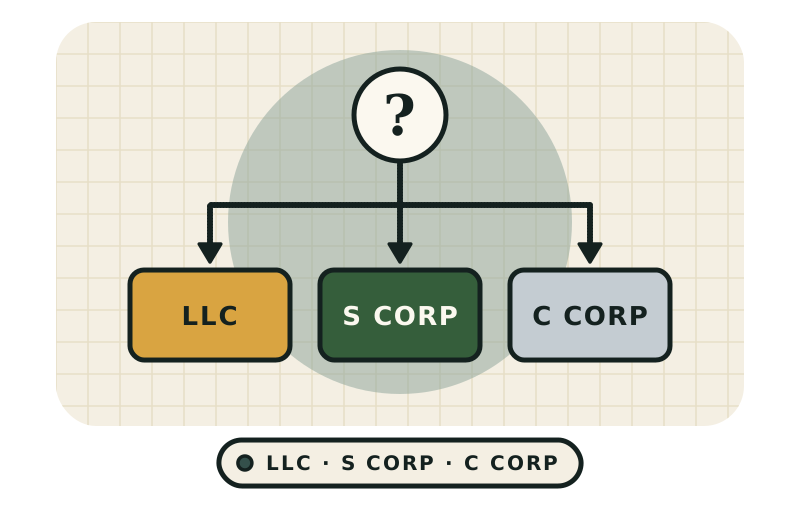
LLC versus S-corp is the wrong comparison, and the confusion costs people real money. An LLC is a legal entity created under state law. An S-corp is a federal tax election, made on Form 2553. An LLC can elect S-corp treatment and remain an LLC in every legal respect: same operating agreement, same registered agent, same liability protection, same EIN, same name on the bank account.
So the real question is narrower. Should the business you already have elect to be taxed as an S corporation? The entity itself is a legal question for an attorney. The election is arithmetic, and you can run it before you commit to anything.
What the election actually changes
Left alone, a single-member LLC is disregarded for federal tax purposes. Your profit lands on Schedule C, and the entire net number carries self-employment tax: 15.3%, which is 12.4% Social Security plus 2.9% Medicare, applied to 92.35% of net earnings, on top of ordinary income tax. A multi-member LLC files Form 1065 and issues K-1s, and an active member's share generally carries the same tax.
Elect S treatment and the profit splits in two. You become an employee of your own company, which pays you a W-2 salary and withholds and matches payroll tax on it. What is left reaches you as a distribution, and that distribution carries no self-employment or payroll tax. The election changes no income tax rate, so the direct benefit is the payroll tax you did not pay on distributions. The indirect effect is not nothing: the salary you set drives your Section 199A deduction, which can move your income tax by more than the payroll tax saved, and I get into that below.
Where the savings quietly stop
The Social Security half of that 15.3% has a ceiling. Once your W-2 wages reach the Social Security wage base, a figure indexed and reset every January, the 12.4% piece stops. Above that line, all your distributions still avoid is the 2.9% Medicare tax, plus the 0.9% Additional Medicare Tax that begins at higher income.
This is why the savings tables floating around online overstate the case at the top. A consultant netting $150,000 sits in the zone where the election does the most work. A physician whose defensible salary already clears the wage base is saving 2.9% on the remainder, not 15.3%. Still real money. Not the number in the table.
What the election costs, in things you have to actually do
These are not soft costs. They are calendar items with penalties attached.
- Real payroll: quarterly Forms 941, an annual Form 940, state unemployment filings, and a W-2 and W-3 every January
- A separate business return on Form 1120-S, due March 15, 2027 for the 2026 tax year, a month ahead of your 1040
- A K-1 issued from your own company to you, which then has to agree with what your 1040 reports
- Shareholder basis tracking on Form 7203, which starts to matter the first year you take a loss or an outsized distribution
- More-than-2% shareholder health insurance premiums added to your W-2 wages, which most payroll providers will not do unless you tell them to
- State-level cost: franchise tax, an annual report fee, a minimum entity tax, or separate state payroll registration, depending on where you are organized
- A late-filing penalty on Form 1120-S charged per shareholder per month, running up to twelve months, whether or not the company owed a dollar of tax
Reasonable salary is the whole ballgame
The distribution bucket only works if the salary bucket is defensible. There is no IRS safe harbor here, and the percentage rules circulating online, 60/40 or a third of gross receipts, are not law. In Watson v. United States a CPA paid himself a salary far below what his practice earned, the court reset the wage figure, and the payroll tax and penalties followed from there.
What the IRS actually weighs is your training and experience, your duties and responsibilities, the hours you put in, dividend history, what the company pays comparable non-shareholder employees, the timing and manner of bonus payments, what comparable businesses pay for similar work, and any written compensation agreement. Underneath all of it sits one question: where did the gross receipts come from? Receipts traceable to your own labor, including the administrative hours nobody wants to count, belong in wages. Receipts generated by employees you hired or by capital and equipment you deployed are what legitimately support a distribution.
Why the profit thresholds you read online are a starting point and nothing more
You will see $40,000 to $80,000 of net profit named as the tipping point, and you will see $200,000 quoted with the same confidence. Both are averages of situations that are not yours. Four things move the real number.
- The gap between net profit and a salary you could defend. A solo practitioner whose receipts are almost entirely his own labor has very little gap to work with; a business with employees and equipment producing revenue has a real one
- Your state, which sets the franchise tax, the minimum entity fee, and whether it respects the federal election at all
- Whether your wages already clear the Social Security wage base, which shrinks the benefit down to the Medicare piece
- How the election collides with your Section 199A deduction
That last one gets missed constantly. Above an income threshold, the Section 199A qualified business income deduction is limited by a formula tied to the W-2 wages your business pays. Cutting your salary to save payroll tax can shrink the deduction by more than the payroll tax you saved. If the business is a specified service trade or business, which includes medicine, law, accounting, and consulting, the deduction phases out entirely at the top of that range and the math changes again. Optimize one lever in isolation and you get an answer that is confidently wrong.
When I tell people not to do it
If your net profit is $30,000 and steady, the answer is no, and it is not close. The payroll filings, the second return, and the state fees will consume the savings and hand you a compliance calendar you did not previously have.
I also say no when income is genuinely unpredictable, because payroll wants a number every quarter and lumpy income turns that into guessing with penalties attached. I say no when someone tells me plainly that they are not going to run payroll on time, because a structure you do not maintain is worse than the one you started with. And it is off the table entirely if the ownership does not qualify: an S corporation cannot have more than 100 shareholders, cannot have a partnership or a corporation as a shareholder, cannot have a nonresident alien shareholder, and cannot have more than one class of stock. One funding round with preferred stock ends the election.
How I run this decision
Establish the profit trend
I want two or three years of actual net profit rather than a projection. One good year is not a structure decision. If the business is new, I usually say wait a year and revisit it.
Price the salary
This is the number that decides everything else, so I build it from your actual role, your hours, and what the work pays in your market. What is left after that is the distribution.
Total the real annual cost in your state
Payroll processing, the 1120-S, the franchise tax or annual fee, and the added bookkeeping the structure requires. That figure is the hurdle the savings has to clear.
Check the interactions, then decide with a number
Wage base, Section 199A, and any state that treats the election differently than the IRS does. You get a dollar figure for both paths, and you make the call knowing what it buys.
If you want the arithmetic run on your numbers
This is the calculation I run under business advisory, usually alongside the bookkeeping that has to be clean before any of it means anything. If you do elect, the payroll and the 1120-S become an ongoing obligation rather than a one-time decision, which is small business accounting work from there forward. Either way you get an estimate in writing before I start, based on the same factors for every client, and you can read exactly how that price gets set.
The first conversation carries no obligation. Send me your numbers and I will tell you which way the math goes, including the times it says the election is not worth it yet.