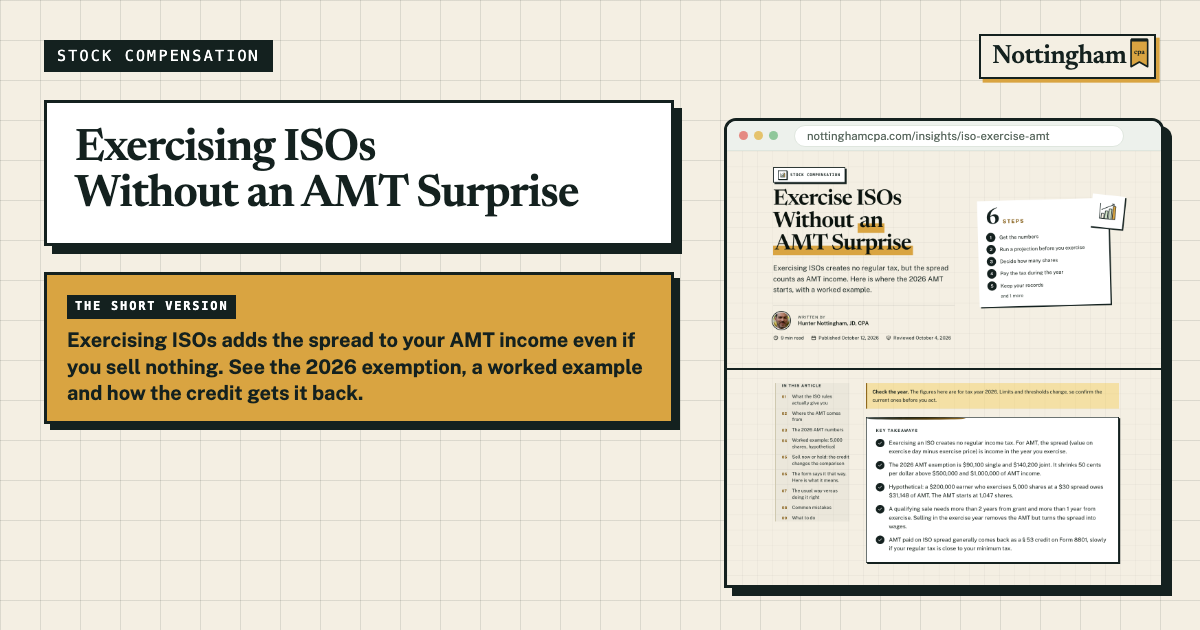
Dollar figures in this piece are for tax year 2026.
Exercising an incentive stock option costs nothing in regular income tax, but it can cost real money in alternative minimum tax. For AMT, the spread (the stock's value on exercise day minus your exercise price) counts as income in the year you exercise, even if you keep every share. You report it on Form 6251, line 2i. It lands on employees who exercise a large block of options in one year and hold the stock.
The bill depends on how many shares you exercise, what the stock is worth that day, and the rest of your income. Below, I run one hypothetical 2026 filer through the numbers, show where the AMT begins, and cover how to keep it from being a surprise.
What the ISO rules actually give you
Under § 421(a), exercising an ISO produces no income. Keep the shares for more than 2 years after the grant date and more than 1 year after the exercise date, and the sale is a qualifying disposition under § 422(a). Your gain is capital gain, measured from the price you paid. None of it is wages.
You also must be an employee of the company, or a related company, at all times from the grant date until 3 months before you exercise. Leave your job and wait longer than that, and the option is treated as a nonstatutory option, which is taxed differently. A separate piece on nonstatutory options covers that case.
Sell before either holding period runs and you have a disqualifying disposition. Per Pub. 525, a sale at a gain makes the gain ordinary income up to the spread at exercise, and anything beyond that is capital gain. A loss is a capital loss with no ordinary income. The ordinary income is wages in the year of the sale, not the year of exercise.
Where the AMT comes from
The AMT is a second tax calculation that runs beside the regular one. You pay the regular tax, and if the tentative minimum tax comes out higher, you pay the difference on top (§ 55(a)). Alternative minimum taxable income starts with your taxable income and applies the adjustments in § 56.
Two adjustments matter here. The standard deduction is not allowed for AMT. And § 56(b)(3) says § 421 does not apply for AMT, so the ISO spread is income. The Form 6251 instructions put it plainly: the excess of the stock's value over what you paid goes on line 2i.
If you sell the shares in the year you exercise, the regular tax and the AMT treat the sale the same way, and no adjustment is needed. The adjustment is for shares you still hold on December 31. Your AMT basis in those shares goes up by the adjustment, so a later sale shows less gain for AMT than for regular tax. Keep both numbers. Form 3921, which your employer should send after the year of exercise, lists the exercise price and the value on the exercise date.
The 2026 AMT numbers
For 2026, Rev. Proc. 2025-32 sets the exemption at $90,100 for a single filer and $140,200 for joint filers. AMT is 26% of the amount above the exemption up to $244,500, and 28% above that. The exemption starts to shrink once AMT income passes $500,000 (single) or $1,000,000 (joint), and it is gone at $680,200 single and $1,280,400 joint.
Under § 55(d)(4), the exemption drops 50 cents for every dollar above the threshold, so a large exercise can use it up fast. Above the threshold, each added dollar of spread is taxed at its own rate and also removes part of the exemption.
Worked example: 5,000 shares, hypothetical
| Line | Regular tax | AMT |
|---|---|---|
| Wages | $200,000 | $200,000 |
| Standard deduction ($16,100 for 2026) | -$16,100 | not allowed |
| ISO spread: 5,000 x ($40 - $10) | $0 | +$150,000 |
| Income after the above | $183,900 | $350,000 |
| AMT exemption (single, 2026) | n/a | -$90,100 |
| Taxable amount | $183,900 | $259,900 |
| Tax | $36,734 | $67,882 |
| AMT owed on top of regular tax | $31,148 |
Example, hypothetical: a single filer has $200,000 of W-2 wages and takes the standard deduction. She holds an ISO to buy 5,000 shares at $10 and exercises it when the stock is worth $40. She pays $50,000 to exercise and keeps the shares. Her regular tax is $36,734 (the 2026 single brackets applied to $183,900). Her AMT income is $350,000. The tentative minimum tax is 26% of the first $244,500 above the exemption plus 28% of the remaining $15,400, which is $67,882. She owes the $31,148 difference on top of the regular tax.
Without the exercise, her tentative minimum tax would be $28,574, well below her regular tax, so she would owe no AMT. In this example the AMT starts at the 1,047th share. Past that point it grows with each share, and above 10,000 shares the exemption begins to phase out as well.
- Regular tax
- Tentative minimum tax
| Regular tax | Tentative minimum tax | |
|---|---|---|
| 0 | $36,734 | $28,574 |
| 1,000 | $36,734 | $36,374 |
| 2,000 | $36,734 | $44,174 |
| 3,000 | $36,734 | $51,974 |
| 4,000 | $36,734 | $59,774 |
| 5,000 | $36,734 | $67,882 |
| 6,000 | $36,734 | $76,282 |
| 7,000 | $36,734 | $84,682 |
| 8,000 | $36,734 | $93,082 |
| 9,000 | $36,734 | $101,482 |
| 10,000 | $36,734 | $109,882 |
The regular tax line stays flat because the exercise adds no regular income. The minimum tax line passes it at about 1,050 shares.
Computed: 2026 single-filer tax table and AMT figures from Rev. Proc. 2025-32; $200,000 wages, $10 exercise price, $40 value at exercise. Horizontal axis is shares exercised.
| AMT owed | |
|---|---|
| 0 | $0 |
| 1,000 | $0 |
| 2,000 | $7,440 |
| 3,000 | $15,240 |
| 4,000 | $23,040 |
| 5,000 | $31,148 |
| 6,000 | $39,548 |
| 7,000 | $47,948 |
| 8,000 | $56,348 |
| 9,000 | $64,748 |
| 10,000 | $73,148 |
Every extra 1,000 shares adds about $7,800 of AMT, at this income. Beyond 10,000 shares the exemption starts to phase out and each share costs more.
Computed from the same inputs as the chart above
Sell now or hold: the credit changes the comparison
Suppose she sells all 5,000 shares at $40 in the same year instead. There is no AMT adjustment, but the $150,000 spread is wages. Her taxable income becomes $333,900 and her regular tax $85,634, which is $48,900 more than before the exercise. The tentative minimum tax is $67,882, below the regular tax, so there is no AMT. She pays more tax in total than by holding and paying $31,148 of AMT.
The reason is the AMT credit. Under § 53, AMT you pay in one year generally becomes a credit against regular tax in later years, claimed on Form 8801. The credit in any year is limited to the regular tax minus the tentative minimum tax. In a later year with the same $200,000 of wages and no ISO exercise, that gap is $8,160, so the $31,148 would take almost four years to recover. A bigger income gap recovers it faster. A year with another large exercise recovers nothing.
Holding also means carrying the price risk. The AMT is computed on the value on exercise day, whatever the shares are worth when the tax comes due. If the stock falls and you sell inside the holding period, you have a disqualifying disposition, and the amounts in § 422(c)(2) and the regulations decide what is taxed. I would run that scenario before exercising, not after.
The form says it that way. Here is what it means.
| What you read | What it means |
|---|---|
| The stock's value on exercise day minus the price you paid | |
| A sale more than 2 years after grant and more than 1 year after exercise | |
| A sale before either period runs, which makes some of the gain ordinary income | |
| The AMT calculation's answer. If it beats your regular tax, you pay the difference | |
| Where the ISO spread is reported as an AMT adjustment | |
| The form that claims the credit for AMT paid in earlier years |
The usual way versus doing it right
Exercise first, count later
- Exercise in December without a projection
- Assume no regular tax means no tax
- Skip Form 8801 on later returns
Project it first
- Run regular tax and minimum tax before exercising
- Find the share count where AMT begins
- Keep a running credit balance and file Form 8801
Common mistakes
- Assuming no regular tax means no tax. The AMT adjustment arrives on Form 6251 even if nothing shows on your W-2.
- Exercising in December without a projection. You will owe the tax in April, or sooner, and nothing was withheld for it.
- Forgetting the standard deduction disappears for AMT. A filer who takes it sees a bigger AMT base than the regular return suggests.
- Using the grant-date price instead of the value on exercise day, which is what the adjustment is based on.
- Selling in the same year and treating the sale as a qualifying disposition. Inside the holding periods it is ordinary income.
- Not tracking a separate AMT basis. After the exercise, your AMT basis is the exercise-day value, and your regular basis is the exercise price.
- Not claiming the credit in later years. Form 8801 has to be filed to use it.
What to do
Get the numbers
Pull the grant date, exercise price, number of vested shares and the current 409A or market value. Your employer's equity portal usually has them.
Run a projection before you exercise
Estimate your income for the year, compute regular tax and the tentative minimum tax, and find the share count where AMT begins. Re-run it at a higher and lower stock price.
Decide how many shares
Exercising up to the point where AMT starts costs no AMT. Going past it is a choice of how much AMT to pre-pay for a shot at capital gain treatment.
Pay the tax during the year
Nothing is withheld on an exercise, so plan estimated payments. See quarterly estimated taxes for the dates, and tax planning if you want the projection done for you.
Keep your records
File Form 3921 when it arrives, and keep a worksheet of regular basis, AMT basis, and the dates that start the 2-year and 1-year clocks.
Track the credit
After a year with AMT, complete Form 8801 on later returns. Keep a running balance, since the limit is figured each year.