The withholding system, and who falls outside it
Income tax is pay-as-you-go. A W-2 employer pulls tax out of every paycheck and sends it in under your Social Security number, so the April return is mostly a reconciliation of money the Treasury already holds.
Nothing withholds on income that does not come from a payroll department. A Form 1099-NEC pays you gross. An S-corp distribution pays you gross. A K-1 reports your share of partnership income whether or not the cash ever reached your bank account. Sell an appreciated position in March and the brokerage wires the proceeds without holding back a dollar. Estimated tax is you doing the withholding job yourself, four times a year.
The trigger is low. If you expect to owe $1,000 or more after subtracting withholding and refundable credits, you are supposed to be paying in during the year. Most people with meaningful untaxed income clear that in the first quarter.
Income that arrives with no tax taken out
One of these is enough to put you in the system.
- Contractor and self-employment income on a Form 1099-NEC, including moonlighting and locum tenens work
- K-1 income from an S-corp or partnership, taxed to you whether or not it is distributed
- S-corp distributions taken on top of your own W-2 salary
- Capital gains, dividends and interest, including one large sale in an otherwise quiet year
- Rental income
- Retirement distributions where you declined withholding, and Roth conversions
The 2026 due dates, and why the quarters are not quarters
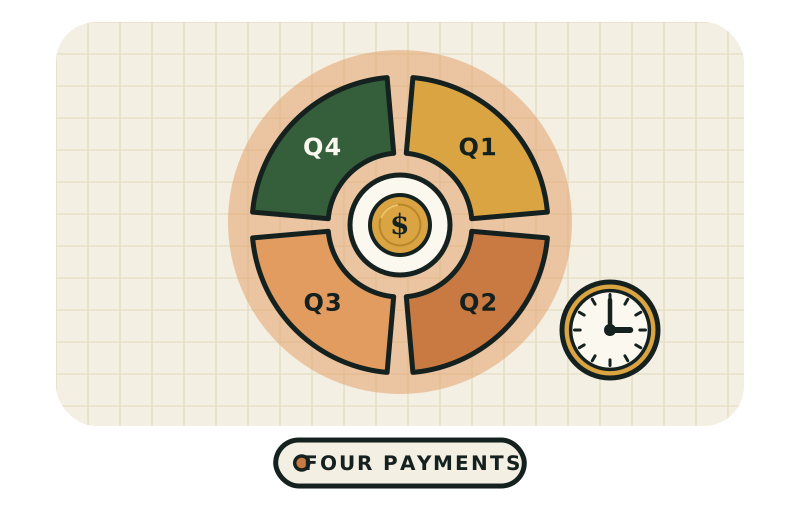
Four payments cover the 2026 tax year. Three land in 2026 and the last one lands in January 2027.
- APR152026Covering income earned January 1 through March 31
- JUN152026Covering April 1 through May 31, a two-month window
- SEP152026Covering June 1 through August 31
- JAN152027Covering September 1 through December 31, a four-month window
Look at the second one. April to June is two months. September to January is four. The word quarterly describes something the calendar is not doing, and a recurring reminder set for the fifteenth of every third month misses June 15 by two weeks and buys interest for the trouble.
These dates also do not move when you extend. An extension pushes a 2026 return's filing deadline to October 15, 2027 and changes nothing about when money is due. The rest of the year's filing and payment deadlines are collected here.
The safe harbor is the part worth understanding
The penalty is not for owing money in April. You can write a very large check with the return and owe no penalty at all. The penalty is for not having enough in the Treasury's hands as the year went along.
There are two ways to be safe. Pay in at least 90 percent of what you actually owe for 2026, or pay in 100 percent of the total tax shown on your 2025 return. If your 2025 adjusted gross income was over $150,000, that second figure rises to 110 percent. The $150,000 threshold is not indexed for inflation, which puts most attending physicians, group partners and profitable business owners in the 110 percent bucket.
When I build a payment schedule, I use the prior-year number, because it already exists and it cannot be guessed wrong. Take total tax from last year's Form 1040, multiply by 1.1 if AGI cleared $150,000, divide by four, and pay that on each of the four dates. You are protected even if 2026 turns out to be the best year you have had.
When the income arrives unevenly
The default assumption is that you earned the money in four equal slices. Real income rarely cooperates. A group practice's K-1 distribution lands in December. An engineering contractor closes three projects in the fall. A rental property sells in October.
Three mechanics matter here, and most people know none of them.
First, the clock runs per period. A payment made on or before a due date counts for that period and carries forward against later ones, so paying ahead works. A payment made after a due date does not reach backward. Interest runs from the missed date until the day the money lands, which is why catching everything up in January fixes less than people expect.
Second, W-2 withholding is treated as paid evenly across the year no matter when it was actually withheld. Raising withholding on a November paycheck retroactively covers the spring. A December estimated payment cannot do that. If you are self-employed and your spouse carries a hospital or corporate W-2, the household's entire shortfall can often run through one Form W-4 change instead of four vouchers.
Third, Form 2210 Schedule AI. The annualized income installment method lets you show the IRS when the money actually arrived, so a December gain is measured against a January deadline instead of being smeared back to April. It requires income and deductions tracked period by period and it adds work at return time. For a large one-time event or genuinely seasonal revenue, that work usually pays for itself.
The penalty is interest, and it behaves like interest
Everyone calls it the underpayment penalty, which makes it sound like a fine for bad behavior. It is interest. The rate is the federal short-term rate plus three percentage points, reset every quarter, figured as simple interest on each underpaid installment, and not deductible.
Framed that way, skipping an estimate on purpose is borrowing from the Treasury at that rate, after tax, with no application to fill out. For most people that is an expensive loan and for a few it is a defensible one. Either way it is a pricing question, not a moral one.
What it is not is forgivable. First Time Abate, the relief people lean on, covers failure to file, failure to pay and failure to deposit. The estimated tax penalty is not on that list. Plan around it, because there is no conversation to have afterward.
The $1,000 trigger and the 90, 100 and 110 percent figures are statutory and steady. The interest rate is not. The IRS resets it quarterly, so check the current number before you price the decision.
When none of this applies to you
If your only income is a W-2 and you get a refund every spring, you do not owe estimated tax and you do not need a quarterly routine. Your withholding is already doing the job. Leave it alone.
If you have modest side income on top of a W-2, the better tool is usually Form W-4 rather than Form 1040-ES. Adjusting withholding at work is one form, filed once, credited evenly across the year. Four separate payments are four separate chances to forget.
And if you overpay every year by a wide margin because it feels safer, name it for what it is: an interest-free loan to the government that comes back the following April. The safe harbor exists so you do not have to guess.
How I handle it
When I finish a return, I calculate the safe harbor for the following year and hand you four dated amounts, not advice to set aside roughly a third of something. If income shifts materially mid-year, that becomes a September conversation instead of an April surprise. Most of what gets called tax planning is exactly this: knowing the number before the date arrives.
For physicians carrying a hospital W-2 alongside moonlighting income, and for partners taking a K-1 from a group practice, the withholding-versus-estimates question is usually the first thing worth fixing, and that work runs to a pattern. If you are not sure which side of the $1,000 line you land on, tell me what your income looks like and I will tell you plainly.