Dollar figures in this piece are for tax year 2026.
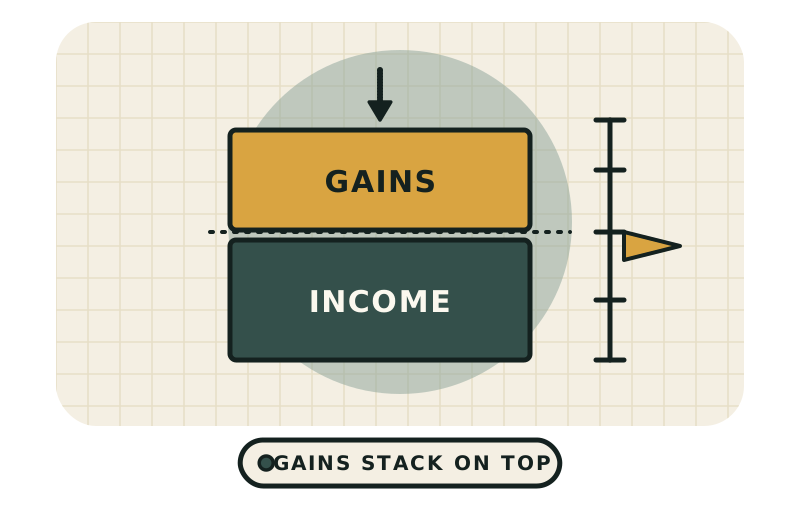
Long-term capital gains and qualified dividends are taxed after your ordinary income, not alongside it. Wages, interest, short-term gains and business income fill the brackets from the bottom. The gains sit on top.
For 2026 the 0% rate covers gains that land at or below $98,900 of taxable income on a joint return ($49,450 single). The 15% rate applies up to $613,700 ($545,500 single), and 20% applies above that. One return can have gains taxed at 0% and 15% at the same time.
Below, you get the order, the 2026 thresholds, and a hypothetical joint return where $64,000 of gains splits between the two lower rates. It covers federal income tax only. The 3.8% net investment income tax is separate and has its own article. For the bracket mechanics underneath, see your bracket is not your tax rate.
The order the Code uses
A gain is long-term if you held the asset more than one year. Anything held a year or less is short-term and taxed as ordinary income. Your long-term gains net of short-term losses make up your net capital gain, and qualified dividends are added to it for the rate calculation.
Section 1(h) works in layers. It first computes tax at regular rates on taxable income reduced by the net capital gain. That is the ordinary layer. The gains are taxed on top of it: 0% up to the zero-rate ceiling, 15% from there up to the 15% ceiling, and 20% beyond. Because the ordinary layer comes first, adding a long-term gain never pushes your wages into a higher bracket. It only decides which rate the gain itself receives.
Three categories sit outside the 0, 15 and 20 pattern: unrecaptured section 1250 gain from real estate depreciation (up to 25%), collectibles gain and certain small business stock gain (both up to 28%). The examples here assume none of those are present. If you sold a rental, see the real estate pages and ask before running the numbers yourself.
The 2026 thresholds
The Code sets the zero-rate and 15% ceilings in 2017 dollars and indexes them for inflation. Rev. Proc. 2025-32 publishes the 2026 amounts. They are measured against taxable income, meaning income after the standard or itemized deduction, not against adjusted gross income. That is why a joint couple can have well over $98,900 of total income and still owe nothing on part of a gain.
The table also shows roughly how much total income each ceiling represents for someone who takes only the standard deduction, which is the figure most people have in mind. Add your own above-the-line items and itemized deductions before relying on it.
Capital gains rate ceilings for 2026
| Filing status | 0% through | 15% through | 20% above | Standard deduction | 0% ends at total income of about |
|---|---|---|---|---|---|
| Married filing jointly | $98,900 | $613,700 | $613,700 | $32,200 | $131,100 |
| Head of household | $66,200 | $579,600 | $579,600 | $24,150 | $90,350 |
| Single | $49,450 | $545,500 | $545,500 | $16,100 | $65,550 |
| Married filing separately | $49,450 | $306,850 | $306,850 | $16,100 | $65,550 |
The tax return says it that way. Here is what it means.
| What you read | What it means |
|---|---|
| Taxable income minus net capital gain, taxed at regular rates first | |
| Your long-term gains, net of short-term losses | |
| Dividends from domestic and qualified foreign corporations, shown in box 1b of Form 1099-DIV | |
| Income after the standard or itemized deduction, not AGI | |
| Held more than one year | |
| The taxable income level up to which gains are taxed at 0% |
Qualified dividends use the same room
Qualified dividends are dividends from domestic corporations and qualified foreign corporations, with a list of exclusions. For the rate calculation they are treated like net capital gain. They share the same 0% and 15% space as your long-term gains and are not stacked separately. Brokers report them in box 1b of Form 1099-DIV, and they go on line 3a of Form 1040. Ordinary dividends that do not qualify are taxed as ordinary income and fill the lower brackets first.
Gains and qualified dividends together are what get measured against the ceilings. Take $20,000 of qualified dividends and you have $20,000 less room to sell a position at the 0% rate.
Example, hypothetical: one return, two rates
A married couple files jointly for 2026 with $85,000 of wages, $4,000 of qualified dividends and $60,000 of long-term gains from selling shares held more than a year. They take the $32,200 standard deduction and have no other income or adjustments. None of the gain is collectibles or depreciation recapture.
Adjusted gross income is $149,000 and taxable income is $116,800. Gains plus qualified dividends are $64,000, so the ordinary layer is $52,800. The ordinary tax on that is $5,840 using the 2026 joint brackets. The zero-rate ceiling is $98,900, which leaves $46,100 of room above the ordinary layer. The first $46,100 of the $64,000 is taxed at 0%. The remaining $17,900 is taxed at 15%, or $2,685.
Total federal income tax is $8,525, and the effective rate on the $64,000 of gains is about 4.2%. Had the same $64,000 been ordinary income, the added tax would have been $9,280. Their modified AGI is under $250,000, so the net investment income tax does not apply.
Same $85,000 of wages and $32,200 standard deduction, using the 2026 joint brackets.
- Taxed at 0%
- Taxed at 15%
- Taxed at 20%
| Taxed at 0% | Taxed at 15% | Taxed at 20% | |
|---|---|---|---|
| Wages $60,000 | $64,000 | $0 | $0 |
| Wages $85,000 | $46,100 | $17,900 | $0 |
| Wages $140,000 | $0 | $64,000 | $0 |
| Wages $700,000 | $0 | $0 | $64,000 |
At low wages all of it is 0%. At $85,000 it straddles the ceiling. Higher wages move it into 15% and then 20%.
Computed from Rev. Proc. 2025-32 joint brackets and the 2026 capital gains ceilings; hypothetical inputs, gains include qualified dividends
Why extra ordinary income can cost more than its bracket
Because the ordinary layer comes first, more ordinary income pushes the gains up the ladder. Say the couple in the example also had a $10,000 Roth conversion or a $10,000 raise. Their ordinary layer would grow to $62,800, still inside the 12% bracket. The room below $98,900 would shrink from $46,100 to $36,100, so $10,000 of gains that used to be at 0% moves to 15%.
The added tax is $2,700: 12% on the $10,000 plus 15% on the $10,000 of gains pushed up. That slice is taxed at an effective 27%, even though the couple is in the 12% bracket. It only happens where gains straddle a ceiling, and it stops once the gains are fully in the 15% zone. Look at the effect on the whole return, not at the bracket alone. Roth conversion math examines this in more detail.
Using the 0% room on purpose
The 0% layer is a planning opportunity in years when ordinary income is unusually low: a gap between jobs, a first year of retirement before distributions begin, or a year with large business deductions. In those years, selling appreciated shares can realize a gain that costs nothing at the federal level, and the shares can be bought back at the higher price. The sale has to happen by December 31 to count for 2026.
Two cautions. First, extra income can have effects outside the capital gains calculation. Anything else that reads your adjusted gross income, such as a health insurance subsidy or a phase-out, may react to the gain. I would check those before selling. Second, state tax is separate. This page covers federal income tax only, and your state has its own rules for the gain. Treat the 0% room as one input in a plan, which is what tax planning is for, and not as a reason to sell something you wanted to keep.
Common mistakes
- Comparing the 0% ceiling to adjusted gross income when it is measured against taxable income, which understates the room by the deduction.
- Forgetting that qualified dividends use the same room as long-term gains, so a large dividend year leaves less space for a sale.
- Treating a position held exactly one year as long-term, when it must be held for more than one year.
- Assuming a gain can never raise tax on ordinary income, and so missing the 27% effect when gains straddle the ceiling.
- Using the 15% and 20% ceilings for an estate or trust, which has separate and much lower amounts.
- Stopping at the 20% rate and missing the 3.8% net investment income tax, which has its own thresholds of $250,000 joint and $200,000 for most others.
The usual way versus doing it right
Guess from your AGI
- Compare the 0% ceiling with adjusted gross income
- Forget that qualified dividends use the same room as gains
- Add ordinary income without looking at the gains
Measure the layers
- Compare the ceiling with taxable income
- Count qualified dividends in the same room
- Run ordinary income choices and gains together
What to do before December 31, 2026
Project 2026 taxable income
Add wages, interest, short-term gains and business income, then subtract the deduction you will take. That is your ordinary layer.
Measure the room
Subtract the ordinary layer and any qualified dividends from your 0% ceiling. That is how much long-term gain could be taxed at 0% this year.
Check the sale dates and holding periods
Only positions held more than one year qualify, and the sale has to happen in 2026 to count for 2026.
Weigh ordinary income choices
A Roth conversion, year-end bonus or retirement distribution adds to the ordinary layer and can push gains into 15%. Run both together.
Pair with losses
Realized losses reduce net capital gain, so check the wash-sale rules before you sell and buy back.