Dollar figures in this piece are for tax year 2026.
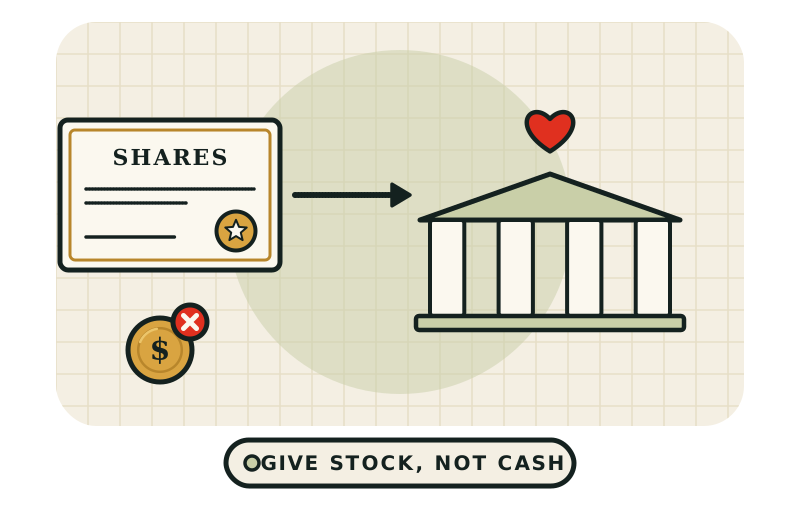
Give long-term appreciated stock straight to a public charity and you deduct the shares' full fair market value. The gain is never reported. Sell first and give the cash, and you pay tax on the gain, then deduct only what you hand over. The charity gets the same $20,000 either way. Your cost is what differs.
The rule fits anyone who itemizes and holds shares worth more than they paid. The gap grows with the size of the gain and the rate you would have paid on it.
What the rule says
Stock is a capital asset, and the Code defines long-term gain as gain from the sale or exchange of an asset held more than one year. A donation is neither a sale nor an exchange, so shares you give away produce no gain to report. The charitable deduction rules then let you deduct the fair market value on the date of the gift, as long as the stock would have produced long-term gain had you sold it.
The same section cuts the deduction by any gain that would not have been long-term. For shares held a year or less, the deduction drops to your basis, which is usually what you paid. Stock bought in January and given in November loses the benefit. Give the same stock in February of the next year and it keeps it.
Private foundations are a second exception. Gifts to one are also reduced by the appreciation, except for what Pub. 526 calls qualified appreciated stock. If the recipient is not a public charity, ask before you move shares.
The gift also has to be complete in the tax year. Under Pub. 526, a properly endorsed paper certificate counts as delivered on the date it is mailed or otherwise delivered to the charity or its agent. If you hand the certificate to your own agent or the issuer to retitle in the charity's name, the gift counts when the transfer is made on the issuer's books. For brokerage transfers, get written confirmation of the date the shares landed.
The limits: 30%, 60%, a new floor and five years
Charitable deductions are capped as a share of your contribution base, which the Code defines as adjusted gross income (AGI). Appreciated stock given to a public charity is capped at 30% of AGI. Cash to the same charity gets 60%. Capital gain property is counted after your other charitable gifts, so a large cash gift in the same year uses up room first.
Whatever exceeds the cap is not lost. The excess is treated as a contribution in each of the next five tax years, in order. Take $60,000 of AGI and a $30,000 gift of qualifying stock: you deduct $18,000 that year and carry $12,000 forward, before the floor described next.
The 2025 tax act added that floor. For tax years beginning after December 31, 2025, charitable contributions are allowed only to the extent they exceed 0.5% of AGI. At $200,000 of AGI, the first $1,000 of gifts produces no deduction. At $720,000 it is $3,600. The floor hits cash and stock alike, so it does not change which route is cheaper. It does mean small gifts may produce nothing.
Which cap applies
| What you give | Deduction amount | AGI cap | Carryforward |
|---|---|---|---|
| Cash | Amount given | 60% | 5 years |
| Stock held more than 1 year | Fair market value | 30% | 5 years |
| Same stock, if you elect to deduct basis only | Basis | 50% general limit in place of 30% | 5 years |
| Stock held 1 year or less | Basis only | Not covered here | Not covered here |
The paperwork says it that way. Here is what it means.
| What you read | What it means |
|---|---|
| Stock or another asset that would have produced long-term gain if you sold it | |
| Your adjusted gross income (AGI), the number the caps are measured against | |
| Usually what you paid for the shares | |
| Gift amount over the cap, treated as a gift in each of the next five years | |
| An account owned and controlled by a sponsoring organization, not by you | |
| The form for noncash gifts when your total is over $500 |
Worked example: $20,000 of stock, $5,000 basis
Example, hypothetical, 2026 rules. Two married couples filing jointly each own shares worth $20,000 that they bought years ago for $5,000, a $15,000 gain. Each wants to give a charity $20,000, each itemizes, and neither makes any other charitable gift. Filer A has AGI of $200,000 before any sale and taxable income of $165,000 excluding the gain, which puts the deduction in the 22% bracket. Filer B has AGI of $720,000 and taxable income of $680,000 excluding the gain, the 35% bracket.
For 2026, the 15% capital gains rate applies up to $613,700 of taxable income for joint filers under Rev. Proc. 2025-32. A pays 15% on the gain. B is above that line, so the gain is taxed at 20%, and B's modified AGI is far over the $250,000 joint threshold for the 3.8% net investment income tax. Cost here means $20,000 given, plus tax on the gain, minus the income tax the deduction saves. State tax is left out.
The two routes side by side
| Line | Filer A | Filer B |
|---|---|---|
| AGI before the sale | $200,000 | $720,000 |
| Rate on the deduction | 22% | 35% |
| Rate on the $15,000 gain | 15% | 20% + 3.8% |
| Give stock: deduction after floor | $19,000 | $16,400 |
| Give stock: income tax saved | $4,180.00 | $5,740.00 |
| Give stock: net cost of the gift | $15,820.00 | $14,260.00 |
| Sell, give cash: tax on the gain | $2,250.00 | $3,570.00 |
| Sell, give cash: deduction after floor | $18,925 | $16,325 |
| Sell, give cash: income tax saved | $4,163.50 | $5,713.75 |
| Sell, give cash: net cost of the gift | $18,086.50 | $17,856.25 |
| Giving the stock saves | $2,266.50 | $3,596.25 |
- Sell, then give cash
- Give the stock
| Sell, then give cash | Give the stock | |
|---|---|---|
| Filer A (15% gains rate) | $18,087 | $15,820 |
| Filer B (20% plus NIIT) | $17,856 | $14,260 |
Giving the shares directly costs the donor less in both cases, because the gain is never taxed.
Computed from the hypothetical in this article using 2026 rates (Rev. Proc. 2025-32; 26 U.S.C. 170, 1411)
Most of the savings is the tax on the gain: $2,250 for A and $3,570 for B. The rest is a small difference in the deduction floor. B comes out further ahead because the 3.8% tax sits on top of 20%.
Holding period matters more than any other input here. The same stock held only 11 months would deduct at its $5,000 basis. That saves $880 of tax for A and $490 for B, which makes net costs of $19,120 and $19,510. For how brackets stack, see your bracket is not your tax rate.
Neither filer is near the 30% cap. A larger gift that pushed against it would use the carryforward. And for a donor whose taxable income reaches the 37% bracket, the Code reduces itemized deductions by 2/37 of the lesser of the deductions or the income above the 37% line, so a deduction there is worth less than 37 cents on the dollar.
Donor-advised funds
A donor-advised fund is an account owned and controlled by a sponsoring organization. You give stock to the sponsor, then recommend grants over time. The statute attaches conditions to the gift. The sponsor cannot be a veterans' organization, fraternal society or cemetery company (nor certain supporting organizations), and you need a written acknowledgment from the sponsor that it has exclusive legal control over what you contributed. Read that phrase as a warning. The gift is final, and the sponsor decides where the money goes, even if it listens to you.
Section 4966 puts a 20% excise tax, paid by the sponsor, on a taxable distribution. That includes a grant to an individual or for a non-charitable purpose. Grants to public charities are not taxable distributions.
A fund helps when you want the deduction this year but have not chosen the charity, or want several years of gifts in one tax year. Check the sponsor's own rules on stock gifts before you rely on it. Minimums and accepted assets vary, and none of that is in the Code.
Common mistakes
- Selling the shares first and giving the cash, which realizes a gain that did not need to be realized.
- Giving shares held a year or less and expecting a deduction at market value. It is limited to basis.
- Giving shares that are worth less than you paid. The deduction cannot include the difference between basis and value, so selling the shares and giving the cash generally makes more sense. Check the loss and wash-sale rules before you sell.
- Treating cryptocurrency like listed stock. Pub. 526 says digital assets are not publicly traded securities for Form 8283 purposes, and appraisal requirements can apply above $5,000.
- Skipping paperwork. A gift of $250 or more needs a written acknowledgment from the charity, and total noncash gifts over $500 need Form 8283.
- Sending stock to a private foundation or an unfamiliar sponsor without checking which deduction rules apply.
The usual way versus doing it right
Sell, then give cash
- Sell the shares and hand over the cash
- Give shares held a year or less and expect full value
- Skip the acknowledgment and Form 8283
Give the shares
- Give shares held over a year straight to the public charity
- Check the holding period before you transfer
- Keep the acknowledgment and file Form 8283
What to do
Pull the lots
Find the purchase date and basis for each lot. Choose lots held more than one year with the largest gain relative to value.
Check that you will itemize
Estimate 2026 itemized deductions against $32,200 (joint) or $16,100 (single). If you would not, consider holding the gift for a year when you will. See also the 2026 rate tables.
Confirm the recipient
Confirm it is a public charity or a donor-advised fund sponsor, and get its transfer instructions. Ask the sponsor for the exclusive-control acknowledgment.
Start the transfer in November
The gift must be complete by December 31, 2026. A paper certificate counts on its mailing date. Ask your broker how it dates an electronic transfer, allow time, and get the date in writing.
Keep the records
Save the charity's acknowledgment, the trade confirmation showing the date and value, and the original purchase record for your basis.
File Form 8283 with the return
Report publicly traded shares on Section A. No appraisal is required for them.