Turning down a raise to stay out of a higher bracket is the most expensive thing I hear people talk themselves into, and it rests on a misreading of one word. Brackets are marginal. Moving into the 24% bracket does not tax all of your income at 24%. It taxes the dollars above the threshold at 24% and leaves everything underneath exactly where it was.
There is no point on the federal rate schedule where earning another dollar leaves you with less money after income tax. Here is the arithmetic, with 2025 numbers.
How the brackets stack
Start with gross income and subtract the standard deduction, or your itemized deductions if they add up to more. What is left is taxable income. For 2025 the standard deduction is $15,750 single, $31,500 married filing jointly, and $23,625 head of household. Taxable income then gets cut into slices, each slice taxed at its own rate, filling from the bottom up.
Nobody skips the 10% bracket. A physician with $900,000 of taxable income and a teacher with $60,000 pay the same federal tax on their first $11,925, down to the dollar. The seven rates are 10, 12, 22, 24, 32, 35 and 37 percent, and the thresholds between them shift every year with inflation. Figures here are the IRS 2025 tables; current ones sit on the rate tables.
One filer, four rates
Take a single filer with $120,000 of wages in 2025 and no itemized deductions worth taking. Taxable income is $120,000 minus $15,750, or $104,250. It slices like this.
- 10% on the first $11,925, which is $1,192.50
- 12% on the next $36,550, up to $48,475, which is $4,386.00
- 22% on the next $54,875, up to $103,350, which is $12,072.50
- 24% on the last $900, which is $216.00
- Total federal income tax: $17,867
- $17,867Federal income tax in the example above, 2025
- 24%Marginal rate, what the next dollar costs
- 14.9%Effective rate, total tax over total income
What a $10,000 raise actually costs
Give that person a $10,000 raise. Taxable income had already crossed the $103,350 line by $900, so every dollar of the raise is taxed at 24%. It adds $2,400 of federal tax and $7,600 of take-home. The $103,350 underneath it is taxed exactly as it was before, to the penny.
Total federal tax goes from $17,867 to $20,267. The effective rate goes from 14.9% to 15.6%. Seven tenths of a point. That is the entire consequence of crossing a bracket line.
Marginal is the next dollar, effective is the average
Your marginal rate is what the next dollar costs. In the example it is 24%: one more dollar of wages, 24 more cents of federal income tax. Your effective rate is total tax divided by total income, an average across every dollar you earned, including the ones taxed at 10%. It is lower than your marginal rate at every income level.
They answer different questions, and using the wrong one has a price. If your effective rate is 15% and you assume a $10,000 deduction saves you $1,500, you are off by $900, because the deduction comes off the top at 24%.
Effective rate is a scoreboard. It tells you what a finished year cost, it makes two years comparable after your income changed, and it is a fair sanity check on a return somebody else prepared. It says nothing about the next dollar.
Use the marginal rate when you are deciding something
- Whether to take a year-end bonus now or push it to January
- What an extra call shift, a locums week, or a 1099-NEC side engagement actually nets
- What a dollar into the pre-tax 401(k) or 403(b) is worth this year
- How much a Roth conversion costs as it fills each bracket above your current income
- Whether a $10,000 deduction is worth $1,200 to you or $2,400
Where your real marginal rate beats your bracket rate
The seven rates in the table are not the whole marginal picture. Other provisions phase in and out across income ranges, and each one raises the cost of the next dollar without appearing on any bracket chart.
The 0.9% Additional Medicare Tax starts at $200,000 of wages single and $250,000 married filing jointly, and those thresholds have never been indexed for inflation. The 3.8% net investment income tax uses the same two figures. For a specified service trade or business, which includes medicine, law and accounting, the qualified business income deduction phases out across a defined range, so a partner sitting inside that range can face a real marginal rate several points above the bracket rate.
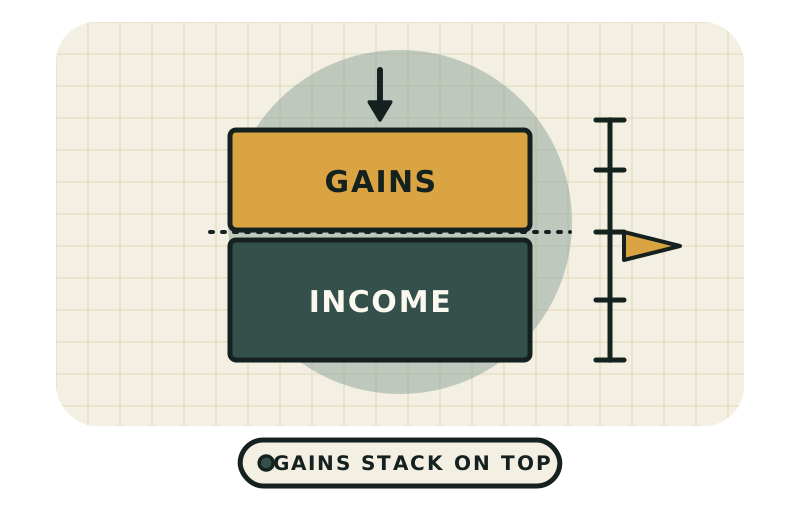
Long-term capital gains stack on top of ordinary income instead of replacing it, which is the usual reason a sale that looked like it belonged in the 0% band gets taxed at 15%. Your true marginal rate is at least your bracket rate and sometimes meaningfully more. The reliable way to find it is to run the return twice, with and without the dollar in question, and subtract.
When this is worth paying someone to do
Often it is not. The arithmetic above is four multiplications and a sum. If your return is one W-2 and the standard deduction, you can do it on paper and be right, and the software will get it right too.
It starts to matter when your marginal rate is not your bracket rate: two attending incomes, a K-1 that arrives with no withholding attached, a Roth conversion sized against next year's income instead of this year's, a year where you get to choose which side of December 31 the income lands on. That choosing is most of what tax planning is, and it has to happen before December 31 to be worth anything. If you want your own number rather than the general shape of it, the contact form starts a conversation.