Dollar figures in this piece are for tax year 2026.
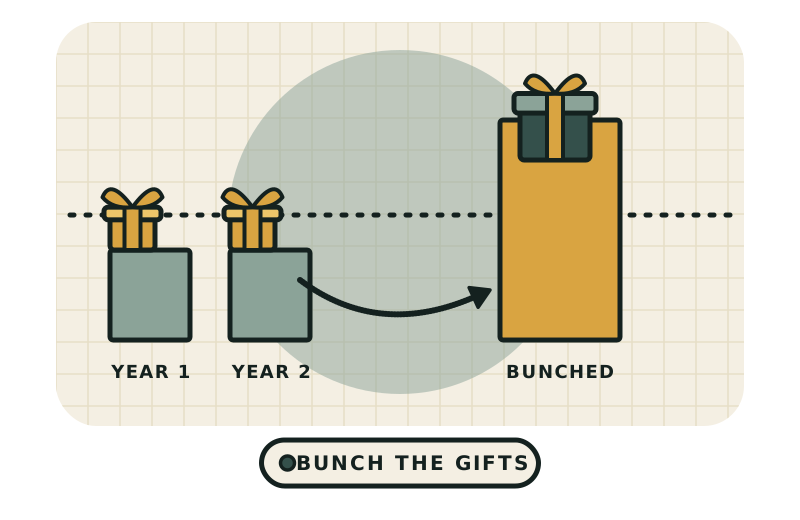
Bunching is a timing move. Your deductions are the same over two years, but you stack them in one year so they clear the standard deduction, then take the standard deduction in the other. It fits people whose itemized deductions sit near or below the standard amount and whose biggest flexible item is charity. For 2026 that line is $32,200 for a married couple filing jointly.
It does not create a deduction you were not entitled to. It only picks the year the deduction lands in. Whether it pays depends on your itemized total, your bracket and a few 2026 rules that changed the math, so run the numbers before you move any money.
The choice: standard deduction or itemizing
You deduct one or the other. Itemizing is an election made on the return, and without it no itemized deduction is allowed. So each year you compare your itemized total with the standard amount and take the larger.
The standard amounts changed in 2025. The 2025 Form 1040 instructions give $31,500 for joint filers, $23,625 for head of household and $15,750 for single filers. That is the post-OBBBA figure. Rev. Proc. 2024-40, which many older articles still cite, shows $30,000 for joint filers and is out of date for 2025. For 2026, Rev. Proc. 2025-32 sets $32,200 joint, $24,150 head of household and $16,100 single or married filing separately.
Couples who file separately face a trap. If either spouse itemizes, the other spouse's standard deduction is zero. Bunching works best on a joint return for that reason.
The 2026 figures that decide the comparison
2026 amount
- Standard deduction, joint$32,200
- Standard deduction, single$16,100
- Standard deduction, head of household$24,150
- SALT cap, state and local taxes$40,400
- SALT cap phase-down30% of MAGI over $505,000, never below $10,000
- Charitable floor for itemizers0.5% of AGI
- Cash gift limit60% of AGI
- Non-itemizer charitable deduction$1,000 single, $2,000 joint
Source
- Standard deduction, jointRev. Proc. 2025-32
- Standard deduction, singleRev. Proc. 2025-32
- Standard deduction, head of householdRev. Proc. 2025-32
- SALT cap, state and local taxes26 U.S.C. 164(b)(7)
- SALT cap phase-down26 U.S.C. 164(b)(7)
- Charitable floor for itemizers26 U.S.C. 170(b)(1)(I)
- Cash gift limit26 U.S.C. 170(b)(1)(G)
- Non-itemizer charitable deduction26 U.S.C. 170(p)
All amounts are for tax years beginning in 2026 unless noted.
See it as a table
| Item | 2026 amount | Source |
|---|---|---|
| Standard deduction, joint | $32,200 | Rev. Proc. 2025-32 |
| Standard deduction, single | $16,100 | Rev. Proc. 2025-32 |
| Standard deduction, head of household | $24,150 | Rev. Proc. 2025-32 |
| SALT cap, state and local taxes | $40,400 | 26 U.S.C. 164(b)(7) |
| SALT cap phase-down | 30% of MAGI over $505,000, never below $10,000 | 26 U.S.C. 164(b)(7) |
| Charitable floor for itemizers | 0.5% of AGI | 26 U.S.C. 170(b)(1)(I) |
| Cash gift limit | 60% of AGI | 26 U.S.C. 170(b)(1)(G) |
| Non-itemizer charitable deduction | $1,000 single, $2,000 joint | 26 U.S.C. 170(p) |
Why the SALT cap matters here
For most households, itemizing starts with state and local taxes: income or sales tax plus property tax. The Code caps that deduction at $40,000 for 2025 and $40,400 for 2026. Above $505,000 of modified adjusted gross income in 2026, the cap shrinks by 30 cents for every dollar over, but never below $10,000. At $600,000 of MAGI the cap works out to $11,900, and the $10,000 floor arrives at about $606,300. After 2029 the cap goes back to $10,000.
A couple under the threshold has real room under a $40,400 cap, so taxes plus mortgage interest may come close to the standard deduction before any gifts. For a higher earner the cap is low and flat, which makes giving the one item you can move at will. I cover the cap itself in the SALT cap on your federal return.
Where the timing comes from
A charitable gift is deductible when you pay it within the taxable year. Publication 526 says a check you mail counts on the day you mail it. That one rule drives bunching: you choose which December the gift lands in.
Sometimes a charity cannot use a large gift all at once. A donor-advised fund handles that. In general terms, it is a fund or account where the donor can advise how amounts are distributed or invested. You contribute once, take the deduction that year, and recommend grants to charities over time. The deduction follows the contribution, not the later grants.
The Code sets two requirements. The sponsoring organization must be one the statute allows, and you need a contemporaneous written acknowledgment from it that it has exclusive legal control over the assets. Ask the sponsor for that letter when you contribute, and have it before you file.
Two 2026 changes that cut against bunching
First, if you itemize in 2026, only charitable gifts above 0.5% of your AGI count. On $300,000 of AGI, the first $1,500 of gifts produces nothing. Bunching helps here, because you absorb the floor once in the big year instead of twice.
Second, a non-itemizer can now deduct cash gifts up to $1,000, or $2,000 on a joint return, on top of the standard deduction. Contributions to establish or maintain a donor-advised fund are excluded. So a couple who gives $2,000 or more in cash directly to charities each year already gets a small benefit without itemizing. Bunching has to beat that, not just the bare standard deduction.
Example, hypothetical: a couple in 2026 and 2027
Take a married couple filing jointly with $300,000 of AGI in each year. They pay $18,000 of state and local taxes and $8,000 of mortgage interest and similar items, so $26,000 of itemized deductions before gifts. The SALT cap does not bind. They want to give $10,000 a year to charity in cash. To keep the comparison clean, I used the 2026 figures for both years and ignored credits, state tax and other items.
Steady giving. Each year is $26,000 plus $10,000 of gifts less the $1,500 floor, or $34,500. That beats the $32,200 standard deduction plus the $2,000 non-itemizer amount ($34,200), so they itemize both years. Total deductions: $69,000.
Bunched giving. In 2026 they put $20,000 into a donor-advised fund: $26,000 plus $20,000 less $1,500 is $44,500. In 2027 they give nothing directly and take the $32,200 standard deduction. Total deductions: $76,700, which is $7,700 more.
Apply the 2026 joint brackets to $300,000 of income less those deductions. Steady giving produces $48,916 of tax in each year, or $97,832. Bunching produces $46,516 in 2026 and $49,468 in 2027, or $95,984. The difference is $1,848. In both patterns the couple's taxable income stays inside the 24% bracket, so the extra $7,700 of deductions is worth 24 cents on the dollar. The donor-advised fund still lets them recommend $10,000 of grants in each year.
- Steady $10,000 a year
- Bunched $20,000 in 2026
| Steady $10,000 a year | Bunched $20,000 in 2026 | |
|---|---|---|
| 2026 | $34,500 | $44,500 |
| 2027 | $34,500 | $32,200 |
| Two-year total | $69,000 | $76,700 |
Bunching gives up nothing in 2027 and still ends $7,700 ahead over the two years.
Computed from Rev. Proc. 2025-32 (2026 standard deduction and brackets) and 26 U.S.C. 170. Hypothetical couple, $300,000 AGI, $26,000 other itemized deductions.
Same income, same giving. The only change is which year the gifts are made.
The result depends on how much you give
Same couple, same $26,000 of other itemized deductions, 2026 figures for both years.
The table
| Gift per year | Steady: two-year deductions | Bunched: two-year deductions | Tax saved by bunching |
|---|---|---|---|
| $6,000 | $68,400 (standard + $2,000 each year) | $68,700 | $72 |
| $10,000 | $69,000 (itemize both) | $76,700 | $1,848 |
| $15,000 | $79,000 (itemize both) | $86,700 | $1,848 |
The tax words, in plain English
| What you read | What it means |
|---|---|
| A flat amount you subtract from income without listing anything: $32,200 joint for 2026 | |
| Adding up your actual deductions instead, which only helps when the total beats the standard amount | |
| A fund or account where the donor can advise how amounts are distributed or invested | |
| For itemizers in 2026, gifts count only above 0.5% of adjusted gross income | |
| The limit on the state and local tax deduction: $40,400 for 2026 | |
| Up to $1,000 ($2,000 joint) of cash gifts, on top of the standard deduction |
The usual way versus doing it right
Give the same every year
- Give the same amount every December
- Use an old standard deduction figure
- Count a fund grant as a second deduction
Price both patterns first
- Compare steady and bunched giving, including the non-itemizer amount
- Use the 2026 standard amounts, $32,200 joint
- Take the deduction once, when you contribute to the fund
Common mistakes
- Using 2025 deduction figures for 2026, or the pre-OBBBA $30,000 joint amount for 2025.
- Treating a donor-advised fund grant as a second deduction. The deduction is taken when you contribute to the fund, not when it pays a charity.
- Forgetting the 0.5% of AGI floor, new for 2026, which trims the itemized charitable amount.
- Bunching without checking the non-itemizer deduction, which already gives joint filers up to $2,000 for direct cash gifts in a standard-deduction year.
- Filing separately when the spouses want different answers. If one itemizes, the other's standard deduction is zero.
- Skipping the written acknowledgment from the donor-advised fund sponsor.
What to do before December 31
Estimate your 2026 AGI
Do this in October. The 0.5% floor, the 60% cash limit and the SALT phase-down all key off income.
Total your itemized deductions without gifts
State and local taxes up to the cap, mortgage interest and the rest. Compare the total with $32,200 joint, $24,150 head of household or $16,100 single.
Price both patterns
Compute steady giving and bunched giving the way the example does, including the non-itemizer amount. If the saving is small, keep giving steadily.
Pick the vehicle
Direct gifts to charities, or a contribution to a donor-advised fund. Confirm the sponsor will issue the written acknowledgment.
Make the gift by December 31
A mailed check counts on the mailing date. Keep the receipt or bank record. See proof for charitable gifts and giving appreciated stock.
Plan the off year
Put the next bunching year on your calendar. Excess over the AGI limits can carry forward for 5 years.
Where this fits
Bunching is one lever among several in a year-end review. The broader list is in the 2026 year-end checklist. If you want it modeled against your actual return, that is what tax planning is for. This article is general information, not advice for your situation.