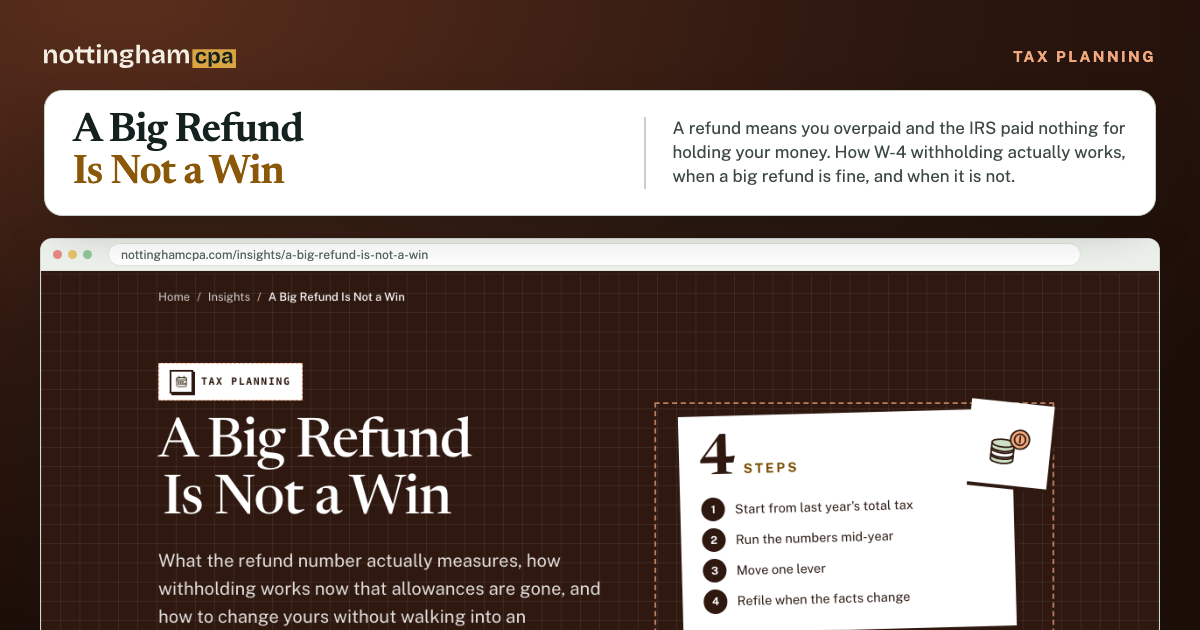
A refund means you overpaid. That is the entire content of the number. The government held the excess for somewhere between a few months and well over a year, handed it back when you filed, and paid you nothing for the use of it.
That is not automatically a mistake. There are real reasons to run a refund on purpose and I will get to them. But most people carrying a large one did not choose it, could not tell you why the number is what it is, and would choose differently if they saw the arithmetic.
What the refund number actually measures
Your refund is total withholding plus refundable credits, minus your total tax. It measures the gap between an estimate your payroll system made in January and the answer your return produced in April. It says nothing about whether your tax was high or low, or whether anything on the return got missed.
Two households with identical income, identical deductions and identical returns can land on a $6,000 refund and a $600 balance due. The difference is entirely what came out of the paychecks. Your tax is set by law and by your facts. Your refund is set by your W-4.
The uncomfortable part: a preparer who wants to look good next April has an easy lever. Nudge a client's withholding up in the spring and the refund grows. The tax did not move an inch.
Allowances are gone, and that changes the math
The W-4 was redesigned in 2020. Allowances no longer exist, so claiming two, or claiming zero to be safe, is advice about a form that has not been printed since 2019. The current version runs five steps: filing status, a multiple-jobs section, a dollar figure for the credits you expect, a place for other income, deductions and extra withholding, and a signature.
The engine underneath matters more than the form. Each employer computes withholding as though that job were your only income all year. It hands that job the entire standard deduction, which the IRS set at $31,500 for a married couple filing jointly for 2025 and adjusts annually, then starts you at the bottom of the bracket table. One job, one paycheck, and that assumption is close to correct.
Two incomes break it. Both employers give you the same full standard deduction and both start you at 10%, while in reality the second income stacks on top of the first at your real marginal rate. Step 2 exists to correct exactly this, and it is the step people skip. If you use the Step 2(c) checkbox, it has to go on both W-4s, not one.
Where withholding usually goes wrong
The pattern is almost always one of these, and none of them are exotic.
- Two earners, and Step 2 was left blank on both W-4s
- A bonus or productivity payment withheld at the flat 22% supplemental rate against a 32% or 35% marginal rate
- K-1 or 1099-NEC income, which carries no withholding at all
- A spouse who started or stopped working mid-year and nobody refiled a W-4
- A W-4 last touched at a job you left before the 2020 redesign
When a large refund is genuinely fine
Forced savings is a real reason and I will say so plainly. If the honest alternative is that the money gets spent, over-withholding is a savings account with a bad interest rate, and a bad rate beats no savings. The interest you gave up is also smaller than the headline suggests, because the balance builds one paycheck at a time. Your average balance across the year is roughly half the refund, not the whole thing.
The other defensible case is income nobody can forecast. Commission, an RSU vest at an unknown price, a K-1 that arrives in September with a number you had no way to predict. A deliberate cushion buys certainty and keeps you clear of the penalty. That is a purchase. Knowing which one you made is the whole point.
When it is costing you
The cost is rarely the forgone interest. It is what the money would have done instead. A $9,000 refund is $750 a month you did not have, and if any part of that year included a revolving credit card balance or an employer match you failed to fund, that refund was expensive.
There is also delivery risk a balance-due filer never carries. Refunds get held for identity verification, delayed by the statutory hold on returns claiming the earned income credit or the additional child tax credit, or offset against defaulted student loans and past-due state debts. The IRS owes you interest only if it fails to issue the refund within 45 days of the later of the due date or the date you filed. Inside that window, your money is free to them.
Changing it without overshooting
Start from last year's total tax
Pull the total tax line off your Form 1040, not the refund line. That figure, not the refund, is the target your withholding has to hit.
Run the numbers mid-year
The IRS Tax Withholding Estimator handles this well, and June is a far better month for it than December, when only a few pay periods remain to absorb the change.
Move one lever
Step 4(c) adds a flat dollar amount of extra withholding per pay period, and it is the most predictable dial on the form. To withhold less, walk 4(c) back toward zero first; below that you are editing the credit figure in Step 3 or the deductions figure in Step 4(b), which move the whole calculation.
Refile when the facts change
Marriage, a second job, a spouse leaving work, a new bonus structure. Each one breaks the assumption your last W-4 was built on.
The penalty waiting on the other side
Cutting withholding too far has a price. You are clear of the underpayment penalty if you pay in at least 90% of this year's tax, or 100% of last year's total tax, or 110% of last year's tax if last year's adjusted gross income was over $150,000. That $150,000 line is not indexed for inflation, so it now catches ordinary two-income households. Owe under $1,000 at filing and there is no penalty at all.
The rate is the federal short-term rate plus three percentage points, reset quarterly and figured without daily compounding, and none of it is deductible. It is also computed period by period, so a large payment in April does not repair a shortfall from the previous September. If your income is genuinely lumpy, Form 2210 Schedule AI lets you match the required payments to the quarters the income actually arrived in.
What this usually turns into
For most of the people I work with, the refund conversation is a withholding conversation, and it belongs in tax planning in June rather than in a return in April. Employed physicians with productivity bonuses, engineers moving between contract and W-2 work, anyone holding a K-1: the withholding machine was built for one job and one paycheck, and none of those look like that.
If you want to know whether your number is a choice or an accident, bring last year's return and a current pay stub to a first conversation. There is no obligation. The dates you are working against are on the due dates page.