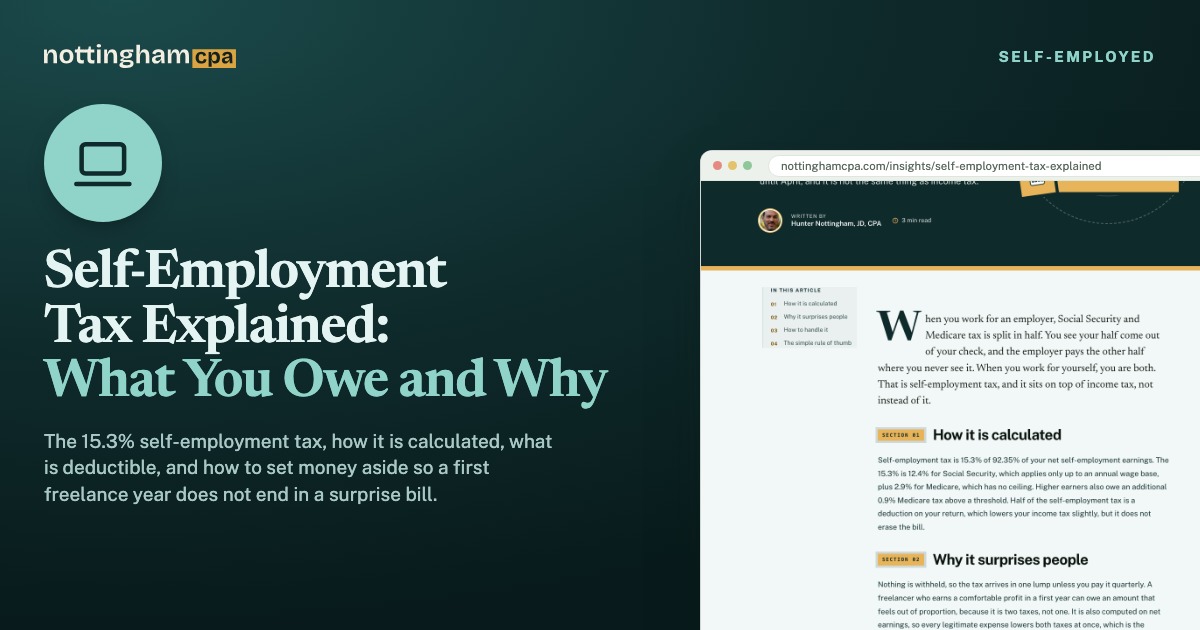
When you work for an employer, Social Security and Medicare tax is split in half. You see your half come out of your check, and the employer pays the other half where you never see it. When you work for yourself, you are both. That is self-employment tax, and it sits on top of income tax, not instead of it.
How it is calculated
Self-employment tax is 15.3% of 92.35% of your net self-employment earnings. The 15.3% is 12.4% for Social Security, which applies only up to an annual wage base, plus 2.9% for Medicare, which has no ceiling. Higher earners also owe an additional 0.9% Medicare tax above a threshold. Half of the self-employment tax is a deduction on your return, which lowers your income tax slightly, but it does not erase the bill.
Why it surprises people
Nothing is withheld, so the tax arrives in one lump unless you pay it quarterly. A freelancer who earns a comfortable profit in a first year can owe an amount that feels out of proportion, because it is two taxes, not one. It is also computed on net earnings, so every legitimate expense lowers both taxes at once, which is the strongest argument for keeping clean records.
How to handle it
- Set money aside from every payment into a separate account, as a percentage of the deposit, instead of a lump in April
- Make quarterly estimated payments, sized to a safe harbor so the penalty is off the table (see Quarterly Estimated Taxes, in Plain English)
- Keep a separate business account so net earnings are provable
- Use retirement contributions designed for self-employment, such as a SEP-IRA or solo 401(k), to lower income tax
- Revisit entity choice once profit is steady: an S corporation can reduce self-employment tax, but only after a reasonable salary and the cost of payroll (see S-Corp vs. LLC)
The simple rule of thumb
There is no single percentage that is right for everyone, because the answer depends on your income, deductions, and state. But treating the first deposit of the year as partly not yours is a habit that turns April from a shock into a payment you planned for. If you would like a number for your situation, start here.