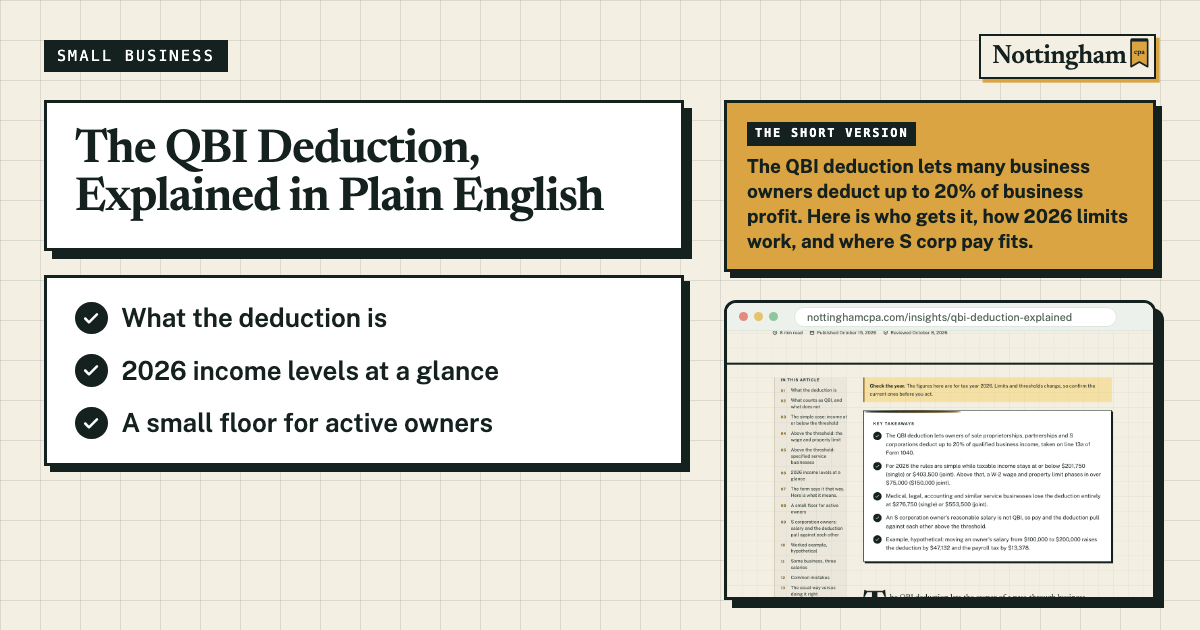
Dollar figures in this piece are for tax year 2026.
The QBI deduction lets the owner of a pass-through business deduct up to 20% of the business's profit from taxable income. It is for sole proprietors, partners and S corporation shareholders. It is not for employees or C corporations, and it has limits that tighten as income rises.
For 2026 the line that matters is taxable income before the deduction: $201,750 for a single filer or $403,500 for joint filers. Below it, the deduction is generally straightforward. Above it, wages, property and the type of business all start to count. This page covers the rule, the limits, and why an S corporation owner's salary shows up in the math.
What the deduction is
Section 199A allows a deduction equal to the lesser of two numbers: your combined qualified business income amount, or 20% of your taxable income minus net capital gain. Qualified business income, or QBI, is the net amount of income, gain, deduction and loss from a qualified trade or business. In plain terms, it is the profit the business earns after its own expenses.
The deduction is reported on line 13a of Form 1040. It lowers taxable income.
What counts as QBI, and what does not
- CountsNet profit from a sole proprietorship, partnership or S corporation that is a trade or business
- Does not countWages you earn as an employee
- Does not countCapital gains and losses, and interest not tied to the business
- Does not countAn owner's reasonable salary and a partner's guaranteed payments
The simple case: income at or below the threshold
If your taxable income before the deduction is at or below the 2026 threshold, the wage and property limit does not apply, and the specified service business rule does not reduce the deduction. You generally take 20% of your QBI, as long as that does not exceed 20% of your taxable income minus net capital gain.
The questions start when income crosses the line.
Above the threshold: the wage and property limit
Above the threshold, each business's deduction cannot exceed the greater of two figures: 50% of the W-2 wages the business pays, or 25% of those wages plus 2.5% of the unadjusted basis of its qualified property. The unadjusted basis, often shortened to UBIA, is roughly the original cost of depreciable equipment and buildings that are still within their depreciable period.
The limit does not switch on all at once. It phases in over $75,000 of income for a single filer and $150,000 for joint filers, so for 2026 it is fully in force at $276,750 (single) or $553,500 (joint). A business with no employees and no depreciable property can end up with a cap near zero, even when its profit is large.
W-2 wages only count if they were reported on a return filed with the Social Security Administration by the 60th day after the due date, including extensions. A late or missing wage report can quietly remove wages from the formula.
Above the threshold: specified service businesses
The second limit applies to a specified service trade or business, usually called an SSTB. The definition reaches businesses in fields such as health, law and accounting, and any business whose principal asset is the reputation or skill of its employees. Engineering and architecture are carved out of the definition.
For an SSTB, the phase-in range removes the deduction itself, not just the cap. Only a shrinking share of the business's QBI, wages and property counts as income rises, and at the top of the range the deduction is gone. A business with gross receipts of $25 million or less is not treated as an SSTB if less than 10% of its receipts come from services in a listed field. See the article on medical practices for how this plays out for physicians.
2026 income levels at a glance
| Filing status | Wage and property limit starts above | Fully in force, and SSTB deduction gone, at |
|---|---|---|
| Single and most others | $201,750 | $276,750 |
| Married filing jointly | $403,500 | $553,500 |
The form says it that way. Here is what it means.
| What you read | What it means |
|---|---|
| Your business profit after its own expenses | |
| Pay your business ran through payroll and reported on W-2s | |
| Roughly what the business paid for its equipment and buildings, still within their depreciable period | |
| A business in health, law, accounting and similar fields, where the owner's skill is the product | |
| The taxable income level where the limits start: $201,750 single or $403,500 joint for 2026 |
A small floor for active owners
For 2026, a taxpayer whose QBI from businesses they materially participate in totals at least $1,000 gets a minimum deduction of $400, even when the regular formula would give less. It is a small amount. The $400 and $1,000 are adjusted for inflation for years after 2026.
S corporation owners: salary and the deduction pull against each other
An S corporation owner who works in the business must be paid reasonable compensation. That salary is wages, so it is not QBI. The company's deduction for the salary also lowers the business's profit, which lowers QBI. So a higher salary means lower QBI.
Above the threshold, though, the same salary feeds the other side of the formula. Wages are what the 50% cap is measured on, so a higher salary can raise the cap. For a business with no employees and no depreciable property, the owner's own salary is often the only wage figure available. Below the threshold none of this applies, because the wage limit is off.
This is the idea behind posts that suggest raising an owner's salary to get a larger deduction. It can be true in the right circumstances. It is not free, because every added dollar of salary carries payroll tax, and the salary still has to be reasonable for the work done. Payments to an officer are treated as wages to the extent they are reasonable compensation, and a salary chosen only to maximize one deduction is hard to defend. The article on what reasonable salary actually means covers how that is judged.
Worked example, hypothetical
Example, hypothetical, 2026: a married couple filing jointly. One spouse owns an S corporation that is not an SSTB. The business earns $700,000 before the owner's pay and payroll tax. It has no other employees and no depreciable property, and the couple's taxable income is above $553,500 in every case, so the wage limit is fully in force.
Payroll tax is 6.2% social security (on wages up to $184,500) plus 1.45% Medicare, paid by both the company and the owner. The table shows three salary choices. QBI is the profit less the salary and the company's half of payroll tax. The deduction is the lesser of 20% of QBI and 50% of the salary.
Same business, three salaries
| Salary | QBI | 20% of QBI | 50% of salary | QBI deduction | Payroll tax |
|---|---|---|---|---|---|
| $100,000 | $592,350 | $118,470 | $50,000 | $50,000 | $15,300 |
| $150,000 | $538,525 | $107,705 | $75,000 | $75,000 | $22,950 |
| $200,000 | $485,661 | $97,132 | $100,000 | $97,132 | $28,678 |
- 20% of QBI
- 50% of salary
- Deduction allowed
| 20% of QBI | 50% of salary | Deduction allowed | |
|---|---|---|---|
| $100,000 salary | $118,470 | $50,000 | $50,000 |
| $150,000 salary | $107,705 | $75,000 | $75,000 |
| $200,000 salary | $97,132 | $100,000 | $97,132 |
At the lower salary, the wage cap is the limit. As salary rises, the QBI cap takes over.
Computed from 26 U.S.C. § 199A(b)(2) with the assumptions above
Moving the salary from $100,000 to $200,000 raises the deduction from $50,000 to $97,132, an increase of $47,132. It also raises total payroll tax from $15,300 to $28,678, an increase of $13,378. The deduction is worth your tax rate times its size. The payroll tax is a straight cost. Which one wins depends on your bracket, and this comparison is simplified, so it is a reason to run your real numbers, not a rule of thumb.
Common mistakes
- Assuming every business owner gets the full 20%, when the wage and property limit and the SSTB rule apply above the threshold.
- Counting wages from a job as QBI. An employee's wages are not a qualified trade or business.
- Setting an S corporation salary only to maximize the deduction, instead of what is reasonable for the work.
- Treating rental income as automatically eligible. A rental has to be a trade or business first.
- Filing W-2 wage reports late, which can remove those wages from the formula.
The usual way versus doing it right
Set it and forget it
- Take whatever number the software shows and move on
- Set an S corporation salary once, in January
- Assume a rental or side business qualifies
Check it against the rules
- Compare your taxable income with the 2026 line first
- Compare the added deduction with the added payroll tax before changing pay
- Confirm the activity is a trade or business, using the rental article
What to do
Find your taxable income before the deduction
Compare it with $201,750 (single) or $403,500 (joint) for 2026. Below the line, the rules are simple.
Sort your income by type
Separate business profit from wages, investment income and rental income, since only some of it is QBI.
Check whether your business is a specified service business
Health, law, accounting and similar fields lose the deduction at the top of the range.
If you own an S corporation, run salary scenarios before year end
Pay has to be reasonable first. Compare the added deduction with the added payroll tax at your rate.
Keep your payroll filings on time
W-2 wages count only if they are on a return filed with the Social Security Administration within the deadline.