Dollar figures in this piece are for tax year 2026.
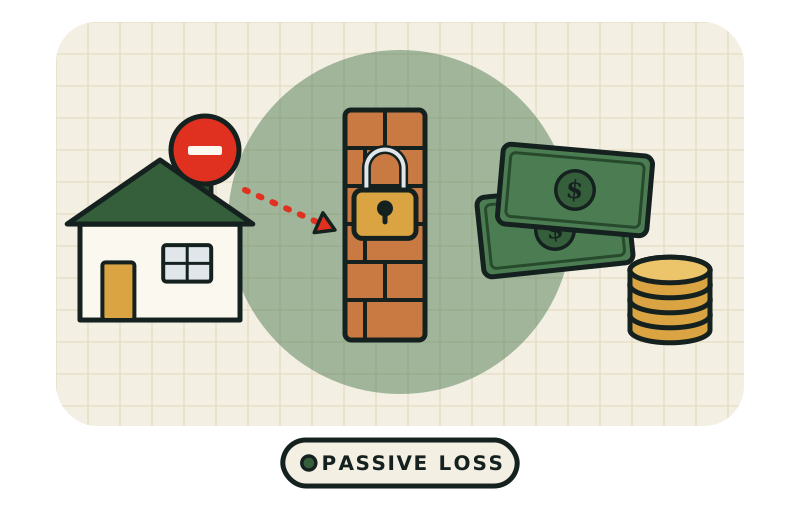
A rental loss is a passive loss, and a passive loss can generally be used only against passive income. With no passive income, the loss is suspended and carried forward, not deducted. The exception most landlords care about is a special allowance of up to $25,000 of rental real estate loss against wages and other income, for an individual who actively participates. It shrinks by 50 cents for every dollar your modified adjusted gross income (MAGI) exceeds $100,000 and is gone at $150,000.
The loss isn't gone for good. It sits on Form 8582 and comes back when the rental earns income, when your MAGI falls, or when you sell the property. Below are the rule, the phase-out arithmetic with a computed 2026 example, the mistakes that wipe suspended losses off the record, and what to do before year end. Depreciation is usually what turns a break-even rental into a paper loss.
What the passive rule says
Section 469 disallows the passive activity loss for individuals, estates and trusts. A passive activity is a trade or business in which you do not materially participate, and the statute adds that any rental activity is passive, whether or not you materially participate. The passive activity loss is the excess of losses from all your passive activities over income from all of them, so one rental's loss can offset another passive activity's income in the same year.
Wages, business income from an active business, and interest and dividends cannot be offset. The statute excludes earned income from passive income. Your passive losses sit in a separate pool, and the pool drains only against passive income or the special allowance described below.
Order matters on the return. Basis and at-risk limits apply first, and only a loss that survives them is tested under the passive rules. A loss that clears the passive rules can still meet the excess business loss limit on Form 461 afterward.
The $25,000 allowance and who qualifies
Section 469(i) lets a natural person deduct up to $25,000 of loss from rental real estate activities in which he or she actively participated. Active participation is a lower bar than material participation. Pub. 925 says management decisions such as approving new tenants, deciding on rental terms and approving expenditures can be enough. You can use a property manager for the day-to-day work and still qualify if you make those decisions in a bona fide way.
Two threshold conditions sit underneath. Your interest, together with your spouse's, must be at least 10% by value of all interests in the activity throughout the year. And a limited partner's interest does not count as active participation except as regulations provide, which matters if a limited partnership holds your rental.
A married person filing separately gets half the numbers: $12,500, with the phase-out starting at $50,000. If you file separately and lived with your spouse at any time during the year, there is no allowance at all.
| Special allowance | |
|---|---|
| $90,000 | $25,000 |
| $100,000 | $25,000 |
| $110,000 | $20,000 |
| $125,000 | $12,500 |
| $140,000 | $5,000 |
| $150,000 | $0 |
| $160,000 | $0 |
For a single filer or a joint return, the allowance is full at $100,000 of MAGI and reaches zero at $150,000.
Computed from 26 U.S.C. § 469(i)(2) and (i)(3)(A): $25,000 less 50% of MAGI above $100,000
Figuring MAGI for this purpose
The phase-out uses adjusted gross income, but not quite the number on Form 1040. The statute and the Form 8582 instructions have you work it out without regard to the passive loss itself, taxable Social Security benefits, deductible traditional IRA contributions, the student loan interest deduction, the deductible part of self-employment tax and a few other items. The IRA add-back is the one that catches people: a contribution that lowers AGI does nothing here.
The add-back list does not name pre-tax deferrals into a workplace plan, so those still reduce AGI and MAGI alike. How that plays out depends on your whole return, so run it with your numbers before relying on it. Portfolio income, and expenses directly allocable to it, stay in MAGI.
Worked example for 2026
Example, hypothetical: a married couple filing jointly has $120,000 of income before the rental loss. They own one rental house, and one spouse approves tenants, sets the rent and signs off on repairs. Depreciation, interest, taxes and repairs exceed rent by $18,000 for 2026. They have no other passive activities. Their MAGI, computed without the rental loss, is $120,000.
The allowance is $25,000 less 50% of the $20,000 by which $120,000 exceeds $100,000, which is $15,000. They deduct $15,000 against their wages and carry $3,000 forward to 2027 as a suspended loss.
Now two versions of 2027. If the house nets $5,000 of income before the carryforward, the $3,000 suspended loss offsets it and $2,000 is taxable. If instead it has a $4,000 loss with MAGI of $130,000, the allowance is $10,000. The $4,000 current loss plus the $3,000 carryforward total $7,000, and all of it is deductible.
The same loss at $100,000 of MAGI would be fully deductible, and at $150,000 or more fully suspended.
The same $18,000 loss at different incomes
Joint return, one rental with active participation, no other passive activity, 2026.
The table
| MAGI | Allowance | Deducted | Suspended |
|---|---|---|---|
| $100,000 | $25,000 | $18,000 | $0 |
| $110,000 | $20,000 | $18,000 | $0 |
| $130,000 | $10,000 | $10,000 | $8,000 |
| $140,000 | $5,000 | $5,000 | $13,000 |
| $150,000 | $0 | $0 | $18,000 |
The form says it that way. Here is what it means.
| What you read | What it means |
|---|---|
| A loss from a rental or a business you do not materially participate in, usable only against passive income | |
| A disallowed passive loss that waits on Form 8582 and carries forward with no expiration | |
| The lower standard for the $25,000 allowance: management decisions such as approving tenants, rental terms and expenditures | |
| Regular, continuous and substantial involvement in operations, a higher bar than active participation | |
| AGI worked out without the passive loss, the traditional IRA deduction and a few other items, used for the phase-out | |
| A fully taxable sale of the whole activity to an unrelated buyer, which releases suspended losses |
Carryforwards, Form 8582 and the sale release
Disallowed passive losses are treated as deductions of the same activity in the next year, with no expiration. Form 8582 is where you track them. You can skip the form only if all of these are true: rental real estate with active participation is your only passive activity, you have no prior-year unallowed passive losses, your loss is $25,000 or less ($12,500 if married filing separately and living apart all year), you have no passive credits, your MAGI is $100,000 or less, and you hold no interest as a limited partner or as a beneficiary of an estate or trust. Miss any one and the form is required, even in a year with no current loss.
A sale is the release valve. When you dispose of your entire interest in the activity in a fully taxable transaction to someone unrelated, the suspended losses are generally allowed in full that year. A sale to a related party does not release them, and a capital loss on the sale is still subject to the $3,000 capital loss limit. The sale mechanics are in selling a rental.
Common mistakes
- Treating a rental loss as deductible because you materially participate. For a rental, material participation alone does not take it out of the passive category.
- Computing the phase-out from the AGI on Form 1040 without adding back items such as the traditional IRA deduction.
- Skipping Form 8582 in a year with no loss, so the suspended amounts go untracked and the next preparer starts from zero.
- Assuming a limited partner or a minority interest under 10% qualifies for the allowance.
- Forgetting that a fully taxable sale to an unrelated person releases suspended losses, and a gift, a related-party sale or a tax-deferred exchange does not.
- Using the Schedule E exception without checking every condition, including no prior-year unallowed losses.
The usual way versus doing it right
Assume the loss just deducts
- Use the AGI on Form 1040 for the phase-out
- Skip Form 8582 in a year with no loss
- Assume a minority or limited partner interest qualifies
Test it, then track it
- Add back the IRA deduction and the other listed items to find MAGI
- File Form 8582 whenever you have suspended losses
- Confirm a 10% interest and who approved tenants, rent and repairs
What to do before the year ends
Estimate MAGI now
Take your 2026 AGI projection, add back the items on the Form 8582 line 6 list, and see where you land against $100,000 and $150,000. Do it in October or November, while there is time to act.
Confirm active participation
Be able to say who approved the tenant, set the rent and approved repairs, and keep the lease, emails or manager approvals that show it.
Gather last year's Form 8582
Your suspended-loss balance by property starts there. If you have never filed one, ask me or your preparer to rebuild it from past Schedule Es.
Plan around the thresholds
If you are close to a line, talk through the timing of income and deductions before December 31 in a tax planning conversation.
File Form 8582 with the return
Include it whenever you have suspended losses, even in a year with no new loss.