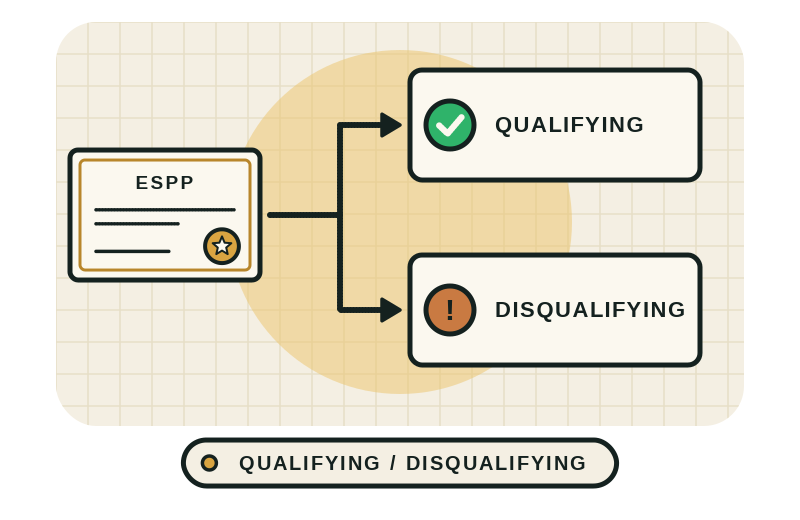
An ESPP sale is either qualifying or disqualifying, and the label decides how much of your profit is ordinary income. To qualify, you must sell more than 2 years after the offering (grant) date and more than 1 year after the purchase date. Meet both and only a small slice, usually the discount, is ordinary income. The rest is long-term capital gain. Miss either and the full discount at purchase becomes ordinary income, whatever the stock does afterward.
Below: the two holding periods, the ordinary-income formula for each outcome, and one worked example computed both ways. Holding RSUs or options too? The equity compensation page and the RSU withholding article cover those separately.
The rule: two clocks, both must run
Section 423(a) gives tax-favored treatment only if you do not dispose of the share within 2 years after the option was granted or within 1 year after the shares were transferred to you. The grant date is the start of the offering period. The purchase date is when your payroll deductions turn into shares. Both dates are on the Form 3922 your employer sends. A sale before both clocks have run is a disqualifying disposition.
There is an employment test too. You must be an employee of the company, or a parent or subsidiary, from the grant date until 3 months before you buy, so leaving a job mid-offering can matter. Check your plan before assuming a sale will qualify.
The purchase itself is not taxed. Under section 421(a), no income results when the shares are transferred to you. The tax shows up in the year you sell, and under section 421(b) your employer is not required to withhold income tax on it. That is why the bill tends to arrive with the return, not on a paycheck.
Plan terms that set the discount
A plan under section 423 can price shares no lower than the lesser of 85% of the stock's value on the grant date or 85% of its value on the purchase date. Many plans use that "lookback" at the full 15%. A plan can also cap purchases: the right to buy may not accrue faster than $25,000 of stock per calendar year, measured at grant-date value. Your plan document and offering terms set the actual discount, so use them instead of assuming 15%.
What is ordinary income and what is capital gain
Disqualifying sale. Ordinary income is the amount by which the stock's value on the purchase date exceeded the price you paid. Pub. 525 says this income is not limited to your gain on the sale, so a falling price does not shrink it. Add the amount to your basis. The difference between the increased basis and the sale price is capital gain or loss: short-term if you held the shares not more than a year, long-term if more than a year.
Qualifying sale. Section 423(c) sets ordinary income at the lesser of two amounts: the sale-date value over the price you paid, or the grant-date value over the option price. Everything above that is capital gain, and it is long-term because the 1-year purchase clock has run. Sell at a loss and it is a capital loss with no ordinary income. The basis again goes up by the ordinary amount.
- 10 daysGrant date (offering begins)
- 2179 daysPurchase date, shares delivered
- 3544 days1 year after purchase (June 30, 2026)
- 4730 days2 years after grant (January 2, 2027)
Day 0 is the grant date, January 2, 2025. The purchase date is June 30, 2025, and a sale qualifies only after both marked dates.
Example, hypothetical: 200 shares, three sale dates
The offering begins January 2, 2025, when the stock is worth $50. Shares are bought on June 30, 2025 at $60, using the lookback. The price is 85% of the lower value, $50, or $42.50. Cost is 200 shares times $42.50, or $8,500, for stock worth $12,000 on the purchase date. Assume the stock is $70 on each sale date, so the total gain over cost is $5,500. Assume also a 24% ordinary bracket and a 15% long-term capital gain rate. Those rates are assumptions. The example ignores state tax, the net investment income tax and the timing of other income.
Sale A, March 2026: held 8 months, so disqualifying. Ordinary income is ($60 minus $42.50) times 200, or $3,500. The remaining $2,000 is short-term gain. Federal tax: $1,320.
Sale B, October 2026: held more than a year since purchase but under 2 years from grant, so still disqualifying. Ordinary income stays at $3,500, and the $2,000 gain is long-term. Federal tax: $1,140.
Sale C, after January 2, 2027: qualifying. Ordinary income is the lesser of $7.50 times 200 ($1,500) and $27.50 times 200 ($5,500), so $1,500. The other $4,000 is long-term gain. Federal tax: $960.
- Ordinary income
- Short-term gain
- Long-term gain
| Ordinary income | Short-term gain | Long-term gain | |
|---|---|---|---|
| A: Mar 2026 | $3,500 | $2,000 | $0 |
| B: Oct 2026 | $3,500 | $0 | $2,000 |
| C: after Jan 2, 2027 | $1,500 | $0 | $4,000 |
Waiting for a qualifying sale moves $2,000 of ordinary income into long-term gain.
Computed: 200 shares, $42.50 price, $50 grant value, $60 purchase value, $70 sale price, hypothetical
| Federal tax | |
|---|---|
| A: Mar 2026 | $1,320 |
| B: Oct 2026 | $1,140 |
| C: after Jan 2, 2027 | $960 |
At assumed 24% ordinary and 15% long-term rates, the qualifying sale costs $360 less than sale A.
Computed from the example with assumed rates of 24% and 15%, hypothetical
When the stock falls: the same shares at $45
Qualifying treatment is not always the better deal, and the formula shows when. Suppose the price drops to $45 before you sell. On a qualifying sale, ordinary income is the lesser of $1,500 and ($45 minus $42.50) times 200, so $500, with no capital gain. On a disqualifying sale at $45, ordinary income is still $3,500, and you also have a capital loss of $3,000, because your basis is $60 a share and you received $45. Net, you are $500 ahead economically either way. The disqualifying sale just puts $3,500 on the ordinary side and $3,000 on the capital-loss side. Capital losses offset capital gains first, so the mismatch hurts most if you have none.
Do not hold a concentrated position just for a tax label. A drop can cost far more than the rate difference. The concentrated stock article covers that risk.
The two outcomes side by side
Qualifying sale
- Holding testMore than 2 years from grant and 1 year from purchase
- Ordinary incomeLesser of grant-date discount or actual gain
- Limited to your gain?Yes
- Capital gain or lossRemainder, long-term
- Basis increaseBy the ordinary income
- Reported onForm 8949 and Schedule D; ordinary part on W-2 box 1
Disqualifying sale
- Holding testEither test missed
- Ordinary incomePurchase-date value minus price paid
- Limited to your gain?No
- Capital gain or lossRemainder, short- or long-term
- Basis increaseBy the ordinary income
- Reported onSame, plus Schedule 1, line 8k if the W-2 omits it
Applies to a plan that satisfies section 423. Basis starts at the price you paid.
See it as a table
| Qualifying sale | Disqualifying sale | |
|---|---|---|
| Holding test | More than 2 years from grant and 1 year from purchase | Either test missed |
| Ordinary income | Lesser of grant-date discount or actual gain | Purchase-date value minus price paid |
| Limited to your gain? | Yes | No |
| Capital gain or loss | Remainder, long-term | Remainder, short- or long-term |
| Basis increase | By the ordinary income | By the ordinary income |
| Reported on | Form 8949 and Schedule D; ordinary part on W-2 box 1 | Same, plus Schedule 1, line 8k if the W-2 omits it |
The plan says it that way. Here is what it means.
| What you read | What it means |
|---|---|
| The start of the offering period | |
| The day your payroll deductions turn into shares | |
| A sale more than 2 years after grant and more than 1 year after purchase | |
| A sale that misses either clock | |
| The part of the gain taxed like wages, with no social security or Medicare tax | |
| The form your employer sends with the grant and purchase dates and values |
How it is reported, and where basis goes wrong
Your employer should report the ordinary income as wages in box 1 of Form W-2. If it does not, you report it yourself on Schedule 1 (Form 1040), line 8k, for the year of the sale. Social security and Medicare tax do not apply to an ESPP option or to a sale of the stock, so the extra wages show up in box 1 only.
For options granted on or after January 1, 2014, the Form 1099-B from your broker will not reflect the ordinary income in its basis. Unless you correct it on Form 8949, you pay tax twice on the amount, once as wages and once as gain. Form 3922, which your employer must furnish by January 31 of the year after the purchase, gives you the dates and values you need.
Common mistakes
- Counting the holding period from the first payroll deduction instead of from the purchase date, which is the day after the option is exercised.
- Letting the 1099-B basis stand, so the ordinary income is taxed again as capital gain.
- Assuming a sale over a year after purchase is qualifying when the 2-years-from-grant clock has not run.
- Forgetting that the ordinary income on a disqualifying sale has no withholding, so the tax is due at filing or through estimates.
- Treating all ESPP gain as capital gain because the discount never showed up in your paycheck.
- Using the wrong dates. The grant date is the offering start, which can be well before any purchase.
The usual way versus doing it right
Sell and sort it out later
- Let the 1099-B basis stand, so the discount is taxed twice
- Count the holding period from the first payroll deduction
- Expect withholding to cover the tax
Date it, then sell
- Correct the basis on Form 8949
- Count from the purchase date, and check the grant date as well
- Plan for the tax with a W-4 change or an estimated payment
What to do before you sell
Pull Form 3922
Find the grant date, purchase date and both fair market values for each lot. If you cannot find it, ask your plan administrator.
Date the two clocks
Mark the later of 2 years from grant and 1 year from purchase. A sale on or before that date is disqualifying.
Compute both outcomes
Run the ordinary income under each rule, as in the example, and compare after-tax proceeds with the risk of waiting.
Plan the payment
No withholding applies to this income, so adjust W-4 withholding or make an estimated payment. See the safe harbor article for the targets.
Fix the basis at filing
Adjust the 1099-B basis on Form 8949 so the ordinary income is not taxed twice.
When to ask for help
Several lots, overlapping offering periods, a plan outside section 423, a move across states during the offering, or a sale in the same year as RSU vesting all change the picture. A planned sale is worth modeling before it happens. See tax planning, and the capital gains stacking article for how the gain sits on top of your other income.