The envelope on your counter is probably not an audit. Most IRS mail comes out of the automated underreporter program, a matching system that lines up the forms filed under your Social Security number against the numbers on your return and prints a proposed change when they disagree. Nobody read your return and decided it looked suspicious. A computer compared two lists.
Most individual examinations are conducted by mail too. A letter asking for documents, not a revenue agent at your kitchen table.
The first thing people do with the envelope is panic. The second is nothing at all, for three weeks. The second one costs more.
Step one: read the code in the corner
Every IRS notice carries a code in the upper right corner. CP and a number, or the word Letter and a number. That code is the only part of the page that reliably tells you what you are holding.
The body text is generated from templates, so a $43 rounding difference and a proposed $60,000 adjustment arrive in roughly the same register. Tone tells you nothing. Look the code up on IRS.gov before you read another sentence and you will know within two minutes whether this is a bill, a proposal, a request for information, or the one document that carries a hard court deadline.
Codes worth recognizing on sight
- CP14: your first bill. A balance is due and a payment date is printed on it
- CP501 and CP503: reminders that the CP14 went unanswered. Escalating in tone, identical in substance
- CP504: notice of intent to levy your state tax refund. Serious, but still not the final levy notice
- LT11 or Letter 1058: the final notice of intent to levy, carrying a 30-day right to a Collection Due Process hearing
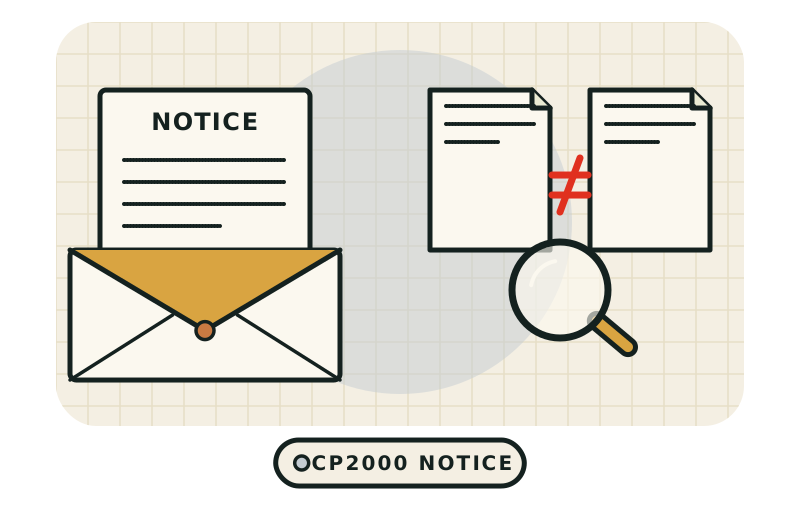
- CP2000: proposed changes from document matching. Not a bill, not an audit, not final
- CP2501: the earlier, softer version of a CP2000, asking you to explain before anything is proposed
- Letter 5071C: identity verification. Your refund is held until the IRS confirms you filed the return
- CP3219A: the statutory notice of deficiency, also called a 90-day letter
Step two: the deadline runs from the date printed on the letter
Not from the day it reached your mailbox, and not from the day you finally opened it. The date at the top of the page starts the clock, and mail sits in piles.
A CP2000 generally gives you 30 days to respond. A CP14 prints its own payment date. A CP3219A gives you 90 days to petition the Tax Court, and that one is different in kind from everything else on the list. It is statutory. The IRS cannot extend it, a phone call does not preserve it, and good faith is irrelevant to it. Miss the 90 days and the assessment becomes final. What is left is paying the tax and suing for a refund, which is a far worse place to argue from.
If you cannot assemble a full answer inside 30 days, respond anyway with what you have and say the rest is coming. A partial response filed on time keeps the file open. Silence closes it and moves you to the next notice in the sequence.
Step three: do not assume the notice is right
The matching program knows what forms were filed under your number. It does not know what any of them mean. When the forms and the return do not tie, it proposes tax on the difference and prints a total.
The common version works like this. A broker reports $340,000 of gross proceeds on a 1099-B with no cost basis reported to the IRS. You paid $325,000 for those shares and correctly reported a $15,000 gain. The computer sees $340,000 of income you never reported and proposes tax on the whole amount. The notice is alarming, the arithmetic inside it is internally consistent, and the answer is a brokerage statement and a one-page letter.
What the matching program actually gets wrong
These are ordinary, recurring failure modes, not exotic ones:
- Securities sales proposed at gross proceeds because basis was never reported to the IRS
- A direct rollover on a 1099-R read as a fully taxable distribution
- The same 1099 issued twice, once as an original and once as a correction that was not flagged as corrected
- Income landing in the wrong year because the check was cut December 28 and deposited January 4
- A dependent claimed on two returns, which is exactly what a Form 8332 arrangement between divorced parents looks like to a computer
- Income belonging to your S corporation reported on a 1099-NEC under your Social Security number
Step four: when to bring in a CPA, and what Form 2848 does
Most notices do not need me. If a CP14 says you owe $1,180 and you know exactly why, pay it or set up an installment agreement in your IRS online account. Paying a CPA to confirm that a correct bill is correct wastes your money, and I will say so on the first call. I am fairly direct about what I am and am not the right answer for.
Bring in a CPA when the proposed adjustment is large, when the notice reaches back into a year whose records you no longer have, when the substance turns on basis or a rollover or entity income and someone has to reconstruct what actually happened, when there are unfiled years sitting behind the notice, or when a 90-day letter has arrived and the deadline is legally fixed. That last one is the work I do most often on the resolution side.
Representation runs through Form 2848, the power of attorney. Signing it lets me speak to the IRS as you: call the practitioner line, pull your account transcripts, argue the substance, negotiate a resolution. It is specific to the form and the years listed on it, so a 2848 covering 2024 Form 1040 does nothing about a 2023 payroll matter. Form 8821 is the lesser cousin. It lets someone see your records and say nothing on your behalf.
CPAs, attorneys, and enrolled agents are the three categories with unlimited representation rights before the IRS. Those rights are federal, which is why a notice for a client in Oregon gets handled from my desk in Charlotte without a second license entering into it.
Before you respond, confirm it is really the IRS
The IRS initiates contact by mail. Not a text, not an email, not a direct message, and never a cold call demanding payment or personal information. A revenue officer assigned to a collection case does call, and can show up in person, but only after letters have already reached you. The private collection agencies the IRS contracts with work the same way: the IRS mails you a CP40 naming the agency, the agency mails its own letter, and only then does the phone ring.
So the rule that protects you is not that the IRS never calls. It is that nothing legitimate starts with the call. If someone phones about a tax problem you have received no mail about, you are not talking to the IRS. A real revenue officer gives you a name and an employee ID you can verify, and never asks you to pay them personally.
The rest of the tells are about money. A real federal balance is paid to the United States Treasury, through your own IRS account or a check written to that name. There is no other correct answer, ever.
Signs the letter or call is a scam
- Demands for gift cards, prepaid debit cards, cryptocurrency, or a wire transfer
- Threats of arrest, deportation, or license revocation if you do not pay today
- Payment directed to any name other than the United States Treasury
- Refusal to let you question, verify, or appeal the amount
- A caller who already has your name but wants you to confirm your Social Security or bank number
- An email or text with a link to verify a refund
Verification is free and takes about a minute. Open your IRS online account and see whether the balance the letter describes actually exists there. A genuine notice matches your account. An invented one does not.
I can't get over how easy it was to work with Hunter. He's great at communicating with me and answered every question I had.
If the letter is still sitting on your counter
Send it to me through the contact form with the code from the corner and the date at the top, and I will tell you what it is, when it is due, and whether you need me for it. Often the honest answer is that this is twenty minutes of your own time and a copy of a brokerage statement.