The hard part of changing accountants is rarely procedural. It's social. People stay years too long with a preparer they've outgrown because they don't want an uncomfortable phone call with someone who has done their returns for a decade.
There is no phone call. No exit interview, no release form, no notice requirement. A prior preparer's engagement ends when you stop signing engagement letters with them. What's left is a document handoff, and the documents are already yours.
What you don't need
Permission. A tax preparer has no ongoing claim on your file, and there's no professional courtesy rule requiring you to ask.
A reason. "I've decided to work with someone else this year" is a complete sentence. Send it in an email, or don't send it at all.
Your old preparer's cooperation. This is the part people don't believe. Almost everything I need is either already in your files or available from the IRS directly. Cooperation makes the first month smoother. It isn't a prerequisite.
And you don't need to worry that I'll call them. I won't, unless you ask me to and there's a reason.
What you actually need to bring
Prior-year returns are the main thing, and two or three years is plenty for most people. Everything after the first line matters only if it applies to you.
- Complete federal and state returns for the last two to three years, every schedule and statement, not just the summary pages
- The depreciation schedule, if you own rental property or business assets
- Form 7203 or a stock basis worksheet, if you own an S-corp
- Carryforwards: capital losses, passive activity losses, charitable carryovers, credits, NOLs
- Form 8606, if you have ever made a nondeductible IRA contribution or a backdoor Roth
- Prior-year K-1s from any partnership, S-corp, or trust
- Prior-year state pass-through entity tax elections, if your group practice or partnership makes them
- This year's documents as they arrive
Switching in the middle of the year
Mid-year is often the better time to move. Nothing about the calendar forces this into January.
Three things have to be picked up cleanly. Estimated payments: I need what you've paid and on what dates, because the underpayment penalty is computed per period and a large April payment doesn't cure a missed September 15 installment. Payroll: if you run an S-corp, wages have to stay continuous through the switch so officer compensation on the 1120-S matches the W-2 you issue yourself. Bookkeeping: if someone else produces your monthly financials, decide whether they stay or the file moves to me. Either answer works.
Move in February with a return due April 15 and an extension is an ordinary tool, not a failure. Form 4868 for individuals, Form 7004 for entities. It extends the filing and never the payment, so I estimate what's owed and you pay that by the original deadline either way.
If a return is already in progress
You can stop mid-engagement. You may owe for work already performed, and if the return was substantially finished, paying that invoice is usually the cheapest way to close it out.
On the documents, Circular 230, the rule set governing practice before the IRS, is direct: a practitioner must promptly return the client records you need to comply with your federal tax obligations, and a dispute over fees generally does not relieve them of that duty. What it doesn't cover is the preparer's own work product, which can generally be withheld, and state law varies on the details. Which is the real argument for keeping a complete copy of your own return every year, long before you think about leaving.
How the handoff runs here
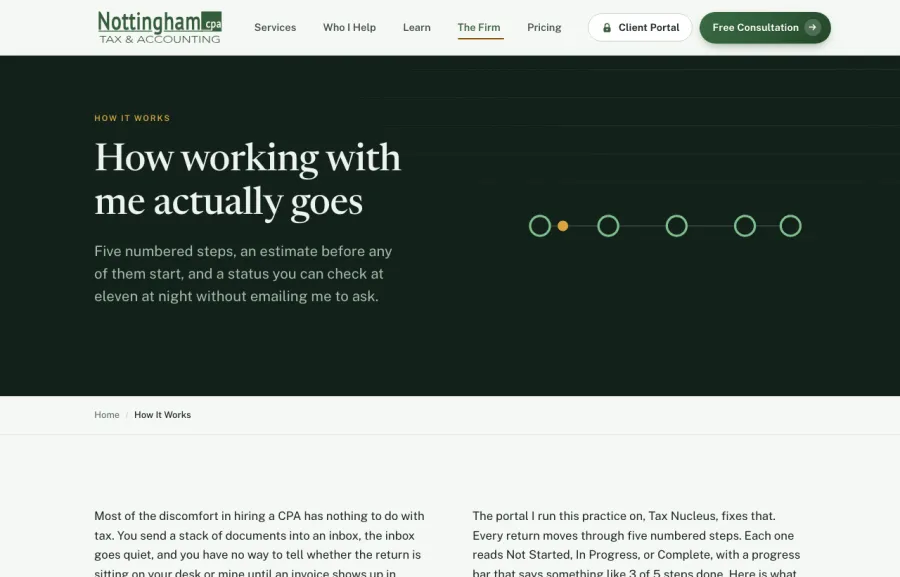
Send the returns
Upload the last two or three years and tell me roughly what has changed since. For most people that's the entire intake burden.
I read them before I give you an estimate
Those returns are the complexity assessment. Income sources, states filed, schedules required, entities involved, and any cleanup the file needs are visible on the face of the return, and those are the same factors that set the price.
You get a written estimate before work starts
A factor-based fee, set from the same factors as everyone else's. If prior-year cleanup is part of the job, it gets named and priced in that estimate instead of appearing on the invoice later.
The year gets picked up where it stands
Estimated payments, payroll, extensions, work already in flight. Nothing restarts at January 1.
What I look for in the prior returns
Reading two or three years back is the most useful part of a new engagement. Patterns show up across years that any single year hides.
The recurring finds are boring and specific. Nondeductible IRA contributions made every year with no Form 8606 ever filed, so the basis is undocumented and the same money is on track to be taxed twice. Depreciation started on the wrong life. A capital loss carryforward dropped during an earlier preparer change and never picked back up. A resident return claiming no credit for tax paid to a nonresident state after a multi-state project year. A Schedule C reporting deposits net of merchant fees while the 1099-K reports gross, which is exactly how a CP2000 gets generated. QBI claimed without running the W-2 wage limitation.
Sometimes I read three years and find nothing wrong. That's a good outcome, and I'll say so plainly rather than manufacture a problem to justify the switch.
Whether amending is worth it
Finding an error and fixing an error are separate decisions. The second one isn't automatic.
First, the window. A refund claim generally has to be filed within three years of when the return was filed or two years from when the tax was paid, whichever is later. Outside that, the money is gone no matter who was right.
Inside the window it's arithmetic. A Form 1040-X usually drags a matching state amendment along with it, so the question is whether the refund clears the cost of preparing both. When it does, file. When it doesn't, I'll tell you to leave it alone. Amending also puts that year back in front of the IRS, which is fine when the position is solid and worth a conversation when it isn't.
The less comfortable version: sometimes a prior return was wrong in the other direction. If I find that, you'll hear it from me. What you do about it is your decision, and there are legitimate options short of panic, but I won't build this year's return on a prior-year position I know to be wrong.
I came over to Nottingham after being with another CPA for many years. The transition was very smooth, and I love the personal attention I get from Hunter.
The actual next step
It's smaller than the version in your head. Send the last two or three years of returns through the contact form, say what has changed, and you'll have a written estimate before any work begins. The first conversation carries no obligation.
How the number gets set is on the pricing page, the full document checklist is on getting started, and if you'd rather read the argument against hiring me first, that page exists too.